
In-depth Analysis of the Tinted Lip Balm Category
Table of Contents
- In-depth Analysis of the Tinted Lip Balm Category: From Category Structure to Private Brand Breakthrough Strategies
- I. Category Niche and Strategic Role: What Position Does Tinted Lip Balm Occupy in the Lip Care Category?
- II. Price Range and Consumer Groups of Tinted Lip Balms
- III. Functional Buttons and Ingredient Trends: Where Lies the Technical Competitive Edge of the Tinted Lip Balm Category?
- IV. Packaging Sizes and Portfolio Strategies: How Can the Tinted Lip Balm Category Drive Profit Through Packaging Design?
- V. Brand Competition Landscape and Breakthrough Strategies for White-Label Products
- VI. Decision Checklist for the Supply Chain of Colored Lip Balm Category
In-depth Analysis of the Tinted Lip Balm Category: From Category Structure to Private Brand Breakthrough Strategies
Tinted Lip Balm is the most unique category in the lip ecosystem — it falls into neither the “pure makeup” nor the “pure skincare” category, but rather occupies the “transition zone” where the two intersect. This ambiguity is both a challenge and the easiest entry point for private labels.

I. Category Niche and Strategic Role: What Position Does Tinted Lip Balm Occupy in the Lip Care Category?

1.1 Category Scale and Growth Logic
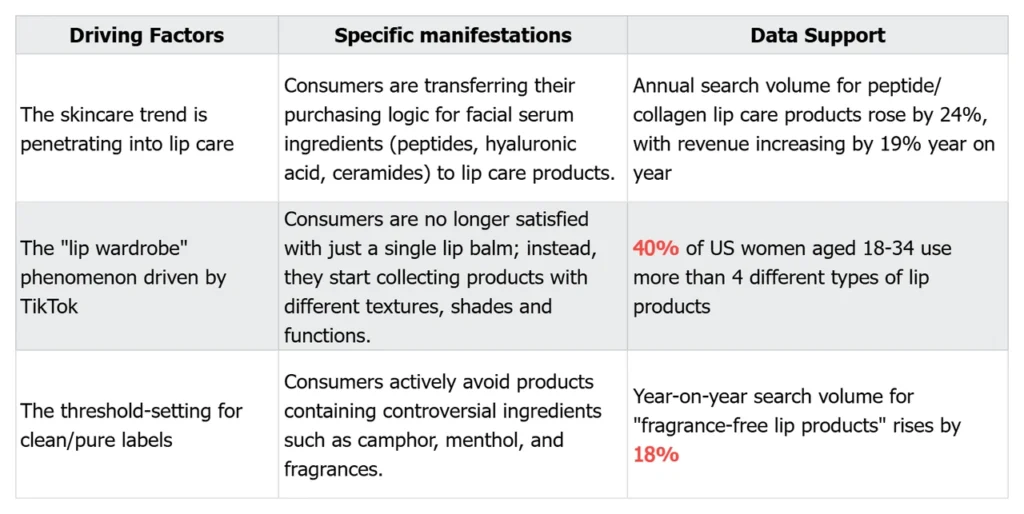
The North American lip care market (including tinted lip balms) is projected to reach a valuation of approximately USD 1.29 billion in 2026, expanding steadily at a compound annual growth rate (CAGR) of 5.8%. Tinted lip balm stands as one of the fastest-growing and most structurally stable subcategories, with the core driving factors as follows:
1.2 The “Three-Stage Rocket” Role Model of Tinted Lip Balm
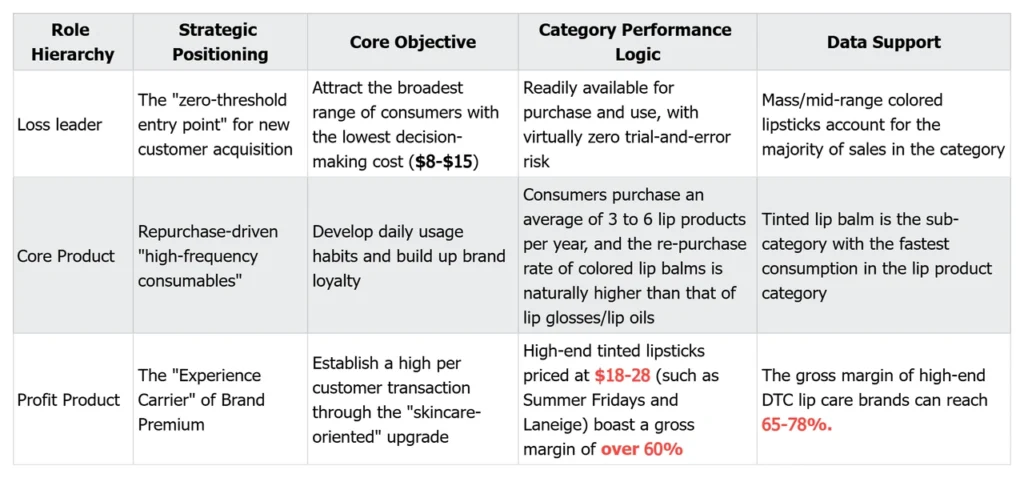
The role that tinted lip balms play in the product matrix is fundamentally distinct from that of lip oils and lip glosses:
1.3 Strategic Niche of Tinted Lip Balm: Why Is It the “Best Starting Point”?
Compared with the lip oils and lip glosses mentioned earlier, tinted lip balms occupy the most strategically flexible position in the lip ecosystem:

Tinted lip balm is the best entry point for private labels to break into the lip care category: it features relatively mature formulas, a low threshold for consumer trust, high usage frequency, and a clear repurchase logic, which enables brands to quickly accumulate initial user feedback and build brand awareness.
II. Price Range and Consumer Groups of Tinted Lip Balms

2.1 Price Tier Pyramid of the North American Colored Lip Balm Market
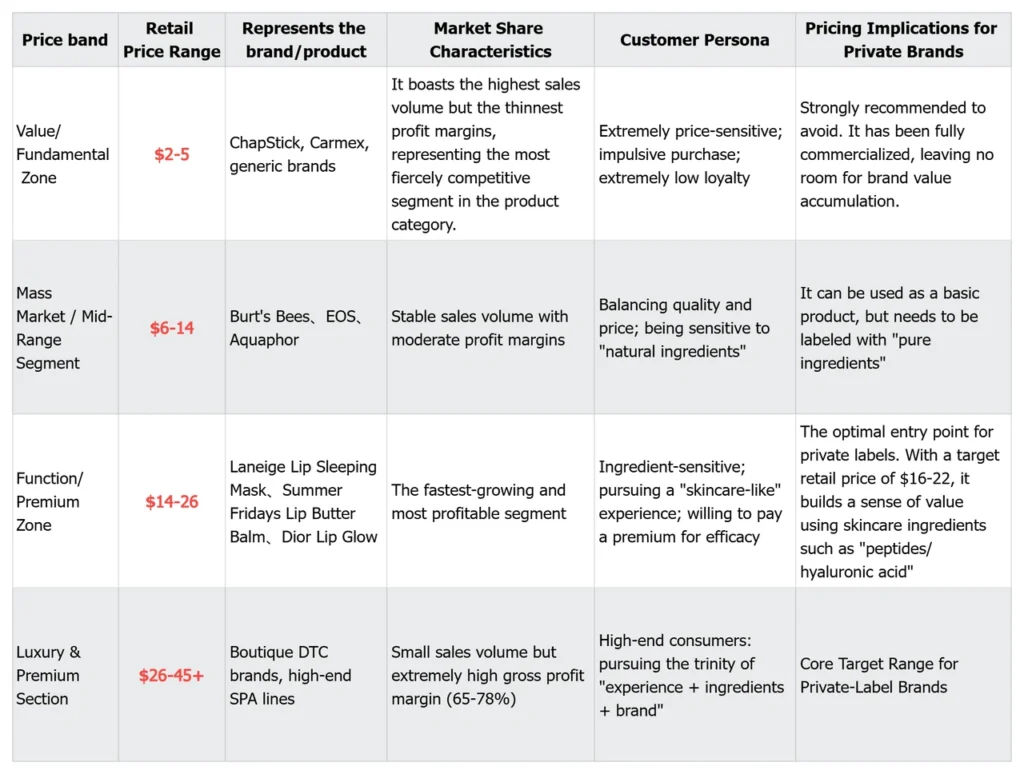
Tinted lip balm is the lip care product category with the widest price range and the most distinct segmentation:
2.2 The Correlation Logic Between Pricing Mechanism and Marketing Strategy
The pricing logic of colored lip balm is completely different from that of lip gloss: the latter is driven by “functional verification”, while the former is driven by “daily habits”.
The “convenience logic” in the $6-14 range:
- Key Indicator: Distribution Breadth > Brand Depth
- Risk: Complete homogenization, leading to a “buy from whoever offers the lowest price” mindset
- Risk: Complete homogenization, leading to a “buy from whoever offers the lowest price” mindset
The “value upgrading logic” in the $16-22 range:
- Key Indicator: Re-purchase Rate > Single Conversion Rate
- Opportunity: Consumers in this price range are willing to read the ingredient list, making this the optimal price bracket for building brand awareness
- Opportunity: Consumers in this price range are willing to read the ingredient list, making this the optimal price bracket for building brand awareness
The “experience logic” for the $25+ range:
- Key Metrics: Brand Search Volume + Social Media Mentions
III. Functional Buttons and Ingredient Trends: Where Lies the Technical Competitive Edge of the Tinted Lip Balm Category?
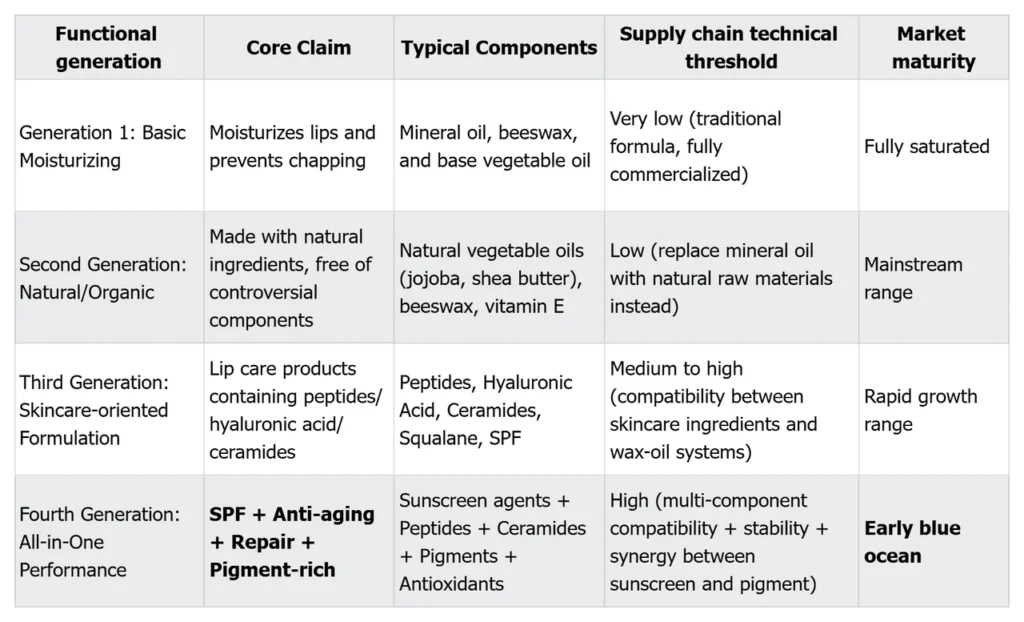
3.1 Functional Evolution Path of Tinted Lip Balm: From “Lip Moisturizing” to “Lip Serum”
Tinted lip balm is the lip care product category with the highest level of “skincare-oriented” positioning:
3.2 Underlying Drivers of Composition Trends
Driving Force 1: Skinification — Lip products are being redefined as “an extension of facial skincare”
The perception that “the lip skin is one of the thinnest skin areas on the face and requires at least the same level of care as the facial skin” is becoming mainstream. Consumers are extending the logic of using facial serum ingredients (peptides, hyaluronic acid, ceramides) to lip care products. Peptide/collagen lip care products have emerged as the fastest-growing segment, recording a 24% search growth rate and a 19% category revenue growth rate.
Driving Force 2: Cleanliness/Purity – Zero Tolerance for Controversial Ingredients
Consumers have learned via social media (particularly the r/SkincareAddiction community on Reddit) that ingredients such as camphor, menthol and fragrances may actually exacerbate lip dryness. Annual searches for “fragrance-free” lip products have risen by 18%, and consumer loyalty to such products is extremely high.
Driving Force 3: SPF Protection — The Unmet Need of Tinted Lip Balms
Tinted SPF lip balm is one of the biggest structural gaps in the current market. Mass-market brands have been slow to move in this category, while consumer demand, especially for summer outdoor scenarios, is extremely strong. Tinted lip balms with SPF see an annual growth rate of 31%, with gross margins ranging from 55% to 68%.
3.3 Key Points of Formulation Technology for Colored Lip Balm Category
The formulation challenge of tinted lip balms lies in the precise balance of the three-phase system consisting of wax, oil and pigment, which represents the category with the highest formulation engineering requirements among the three types of lip products:
When evaluating suppliers of tinted lip balms, private label brands should focus on three key technical capabilities:
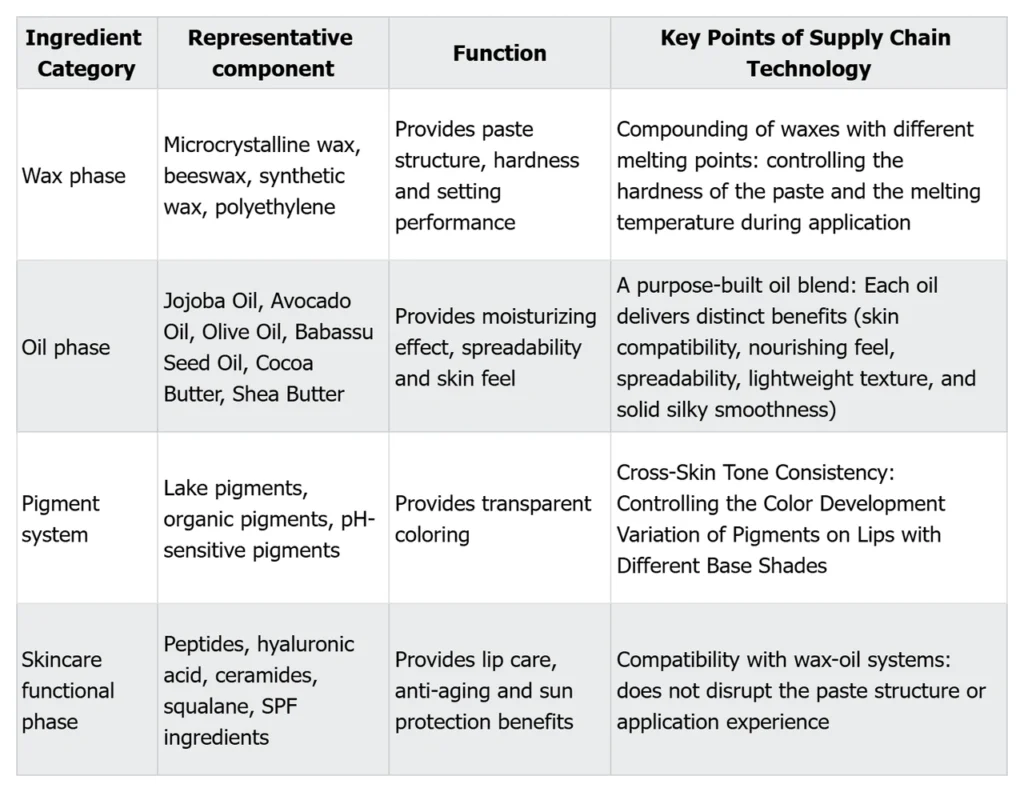
- Inter-batch Color Difference Control — Color Consistency Across Different Batches of the Same Color Code
- Compatibility of Skincare Ingredients with Wax-Oil Systems: Has the Balance Between Lip Hydration and Color Payoff Truly Been Achieved?
- Compatibility of Skincare Ingredients with Wax-Oil Systems: Has the Balance Between Lip Hydration and Color Payoff Truly Been Achieved?
IV. Packaging Sizes and Portfolio Strategies: How Can the Tinted Lip Balm Category Drive Profit Through Packaging Design?

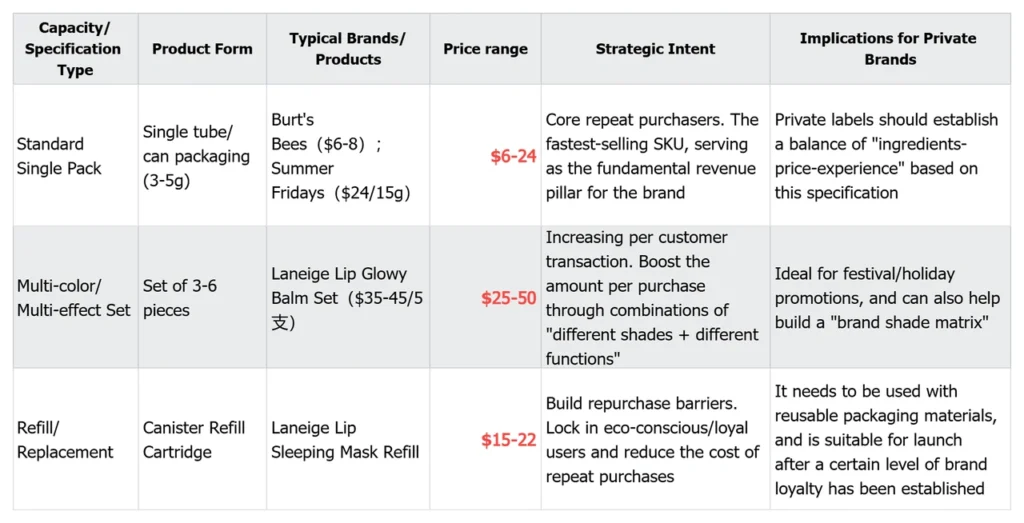
4.1 Mainstream Specifications and Pricing Strategy
The specification logic of colored lip balm is completely different from that of lip gloss: it relies more on the repurchase attribute of “consumables” rather than the trial-and-error attribute of “trying something new”.
4.2 Underlying Logic of the Specification Combination Strategy
The “3-piece pack” strategy for tinted lip balm offers multiple values:
- Gift-oriented: Multi-pack products are naturally suitable as gift sets, which can help seize the peak holiday sales season
- Perceived value: The 3-pack is priced at $25-35, which consumers perceive as “only $8-12 per unit”, creating a stronger sense of “great value” compared to the single-unit price of $12-15.
- Perceived value: The 3-pack is priced at $25-35, which consumers perceive as “only $8-12 per unit”, creating a stronger sense of “great value” compared to the single-unit price of $12-15.
Colored lip balms with SPF represent the fastest-growing segment, with an annual growth rate of 31%, while mass-market brands have been slow to make moves in this field. Private labels can position “SPF 30+ colored lip balms” as their core offering to establish a clear identity in the highly competitive market.
V. Brand Competition Landscape and Breakthrough Strategies for White-Label Products

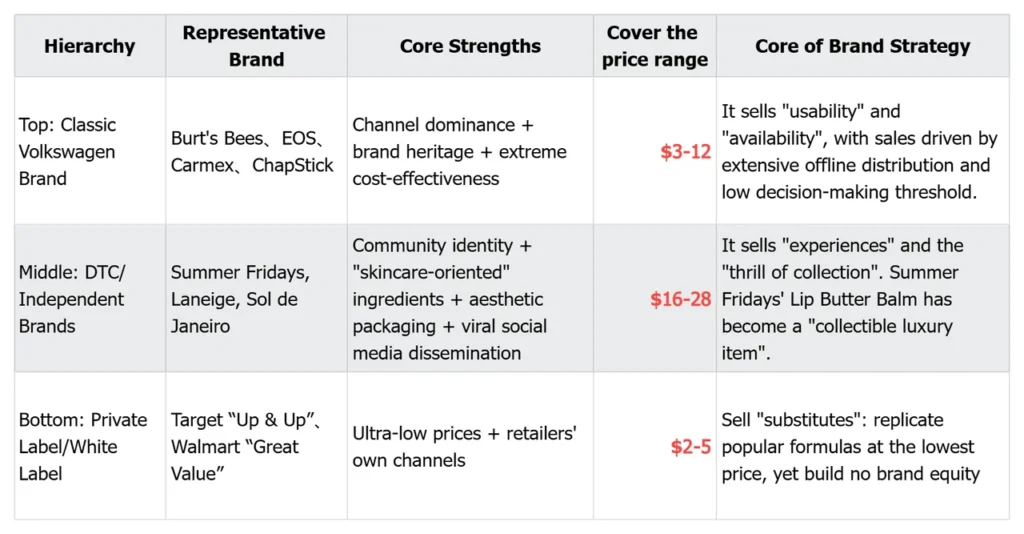
5.1 Current Brand Landscape of the Tinted Lip Balm Category
Tinted lip balm is the category that private labels can enter most easily, yet is also the most prone to commoditization:
5.2 Breakthrough Strategies for Mid-Tier Brands in the Tinted Lip Balm Category
The competitive landscape of tinted lip balms is more “polarized” than that of lip glosses: leading mass-market brands and leading DTC brands capture the majority of consumers’ attention, while the differentiation opportunities in the middle ground are concentrated on “unmet needs”:
Strategy 1: Avoid competing in the “basic lip balm” segment, and instead enter the “functional tinted lip balm” market
Basic tinted lip balms (priced at $6–14) have been fully commercialized, with leading brands locking in the market via their channel advantages. Private labels should steer clear of this price bracket and directly target the functional segment in the $16–22 range:
- Peptide/Ceramide Lip Care: 24% Growth Rate, Consumers Willing to Pay a Premium for “Skincare-Grade Lip Products”
- Fragrance-free/Sensitive Lip Formula: Search volume increases by 18% year-on-year, with high consumer loyalty and relatively low competition
- Fragrance-free/Sensitive Lip Formula: Search volume increases by 18% year-on-year, with high consumer loyalty and relatively low competition
Strategy 2: Build trust through “ingredient transparency” and “certifications” instead of being “just another lip balm”
Consumers have a low decision-making threshold for colored lip balms, but their “ingredient awareness” is rapidly growing. Over 50% of consumers prioritize products that are “safe and toxin-free. ” Even for white-label products, establishing trust on par with major brands is achievable by making third-party test reports publicly verifiable and clearly labeling “XX-free” on the packaging.
Strategy 3: Build a “Brand Shade Matrix” by leveraging “makeup sets”
When consumers buy tinted lip balms, they often do not purchase just a single one, but rather a full set. Laneige’s 5-piece sets and the shade-collecting culture around Summer Fridays both demonstrate that tinted lip balms are evolving from “functional consumables” into “collectible consumer goods”. Private labels should make the most of this trend:
- Launch the “three-piece set” as the core sales unit to reduce the cost of a single decision while increasing the per customer transaction
VI. Decision Checklist for the Supply Chain of Colored Lip Balm Category

Based on the above analysis, when private label sellers evaluate the colored lip balm category and select suppliers, they should focus on the following core issues:
Regarding category positioning:
- Which functional direction did you choose as your differentiation label (SPF/peptides/fragrance-free)?
Regarding Price and Profit:
- Have you considered the “3-piece set” as a core leverage for per customer transaction?
Regarding Functions and Ingredients:
- Have you chosen SPF protection as your differentiated entry point? The annual growth rate of SPF-containing products stands at 31%.
Regarding Specifications and Packaging:
- Have you considered the “3-piece set” as the core SKU format?
Regarding supplier capabilities:
- Can the supplier control the color difference between different batches? Can it adapt to the color rendering variation of lips with different base tones?
- Does the supplier’s MOQ match the scale of your initial order and your tolerance for inventory risk?
- Does the supplier’s MOQ match the scale of your initial order and your tolerance for inventory risk?