
The Semi-Custom Formulation Playbook: Accelerating Your Brand’s Premium Journey
Table of Contents
A deep dive into how private label brands can leverage stability-verified bases, customize with hero ingredients, and own their finished SKU—without full custom OEM or ODM R&D.
Introduction
For private label brands, the path to premiumization often starts with a critical decision: full custom OEM/ODM development or semi-custom formulation? While full custom offers maximum differentiation, it comes with significant costs and timelines. Semi-custom formulation offers a powerful alternative—one that many successful brands are now choosing to accelerate their market entry while still achieving premium positioning.
This playbook explores how semi-custom formulation works, what it means for brand ownership and control, and how private label brands can use this approach to launch premium products with speed and confidence.
This guide is part of our comprehensive series on private label premiumization. For a complete overview of the strategy, read the main guide here →
Choosing the right hero ingredients is a critical next step. Explore our guide to ingredient selection →
What Is Semi-Custom Formulation?
Semi-custom formulation sits between ready-made private label products and fully custom OEM or ODM development. It starts with a stability-verified base formulation—a proven formula that has already passed rigorous microbial, stability, and preservative efficacy testing—which is then modified with specific active ingredients, scents, textures, or colors.
The typical semi-custom pathway:
- Select a base from the manufacturer’s proven formulation library
- Choose hero ingredients to augment the base (peptides, vitamins, botanicals, etc.)
- Customize sensory elements (texture, scent, color)
- Conduct targeted stability testing for the augmented formula
- Move to production with custom packaging and branding
This model offers a significant advantage in time-to-market. While full custom OEM or ODM R&D typically requires 12-18 months, semi-custom customization and compatibility testing can be completed in weeks rather than months.
Who Owns the Formula?
One of the most common questions private label brands ask is: “Who owns the formulation?”
In a semi-custom model, the answer is typically split:
- The base formula remains the manufacturer’s intellectual property. This is the foundation that has been tested and proven over time.
- The finished SKU profile—the unique combination of base plus actives—belongs to the brand. This includes the specific active ingredient blend, texture modifications, and sensory profile that define the final product.
This ownership model allows brands to differentiate while keeping costs controlled. The brand owns the unique formula profile that makes the product distinct, while leveraging the manufacturer’s OEM expertise and ODM infrastructure for the foundation.
Fir Beauty operates on this model, providing brands with full ownership of their finished SKU profile while maintaining the stability and quality of proven bases. Whether you’re pursuing an OEM partnership or a full ODM project, our team ensures you have clear visibility into what belongs to you and what forms the foundation of our shared success.
The Semi-Custom Advantage for Private Label Brands
1. Speed to Market
With full custom OEM or ODM R&D, brands often wait 12-18 months to launch. Semi-custom can compress this to 8-12 weeks. For brands looking to capture seasonal demand or respond to market trends, this speed is invaluable.
2. Lower Investment
Full custom requires significant R&D investment. Semi-custom leverages proven bases, reducing development costs and allowing brands to allocate budget to packaging, marketing, and inventory.
3. Reduced Risk
Proven bases have already passed stability testing. While the augmented formula requires additional testing, the risk is substantially lower than starting from scratch.
4. Flexibility
Semi-custom allows brands to adjust actives, scent, and texture without rebuilding the entire formulation. This makes it easier to iterate and respond to consumer feedback.
5. Scalability
Many semi-custom manufacturers offer lower MOQs, allowing brands to test products before scaling. This “test and learn” approach reduces risk and informs future OEM or ODM development.
How to Spot a Problematic OEM/ODM Partner
Not all semi-custom partners are created equal. Here are critical red flags to watch for when evaluating a potential OEM or ODM manufacturer:
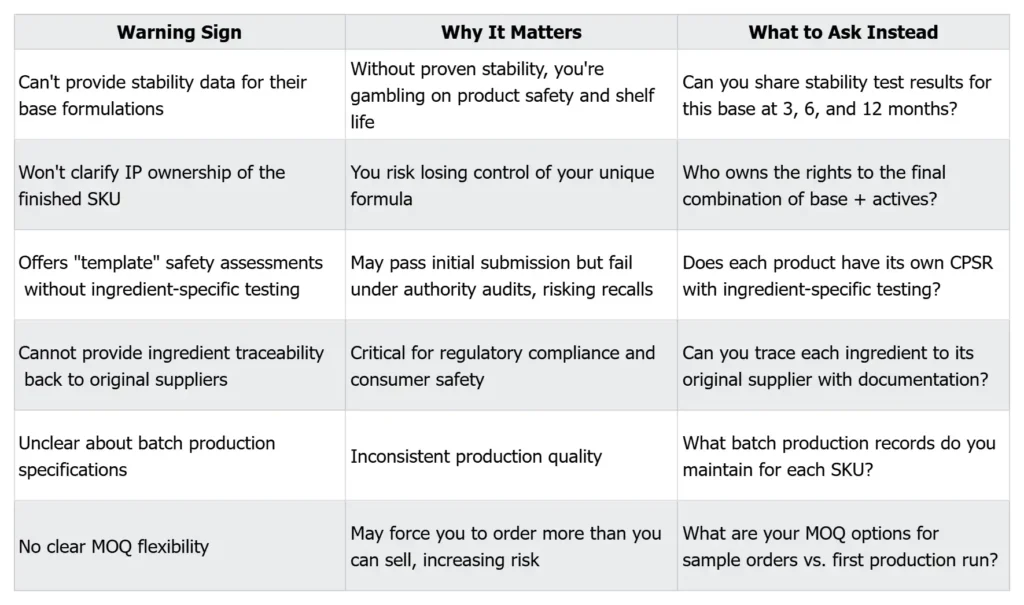
A transparent OEM or ODM partner will answer these questions readily. If a partner is evasive or unclear, consider it a significant warning sign.
Fir Beauty provides clear answers to all these questions upfront. Our dedicated account managers walk brands through every aspect of the semi-custom process—from base selection to IP ownership to stability testing—so there are no surprises.
How to Choose Your Semi-Custom Partner
When selecting a semi-custom OEM or ODM manufacturer, ask these key questions:
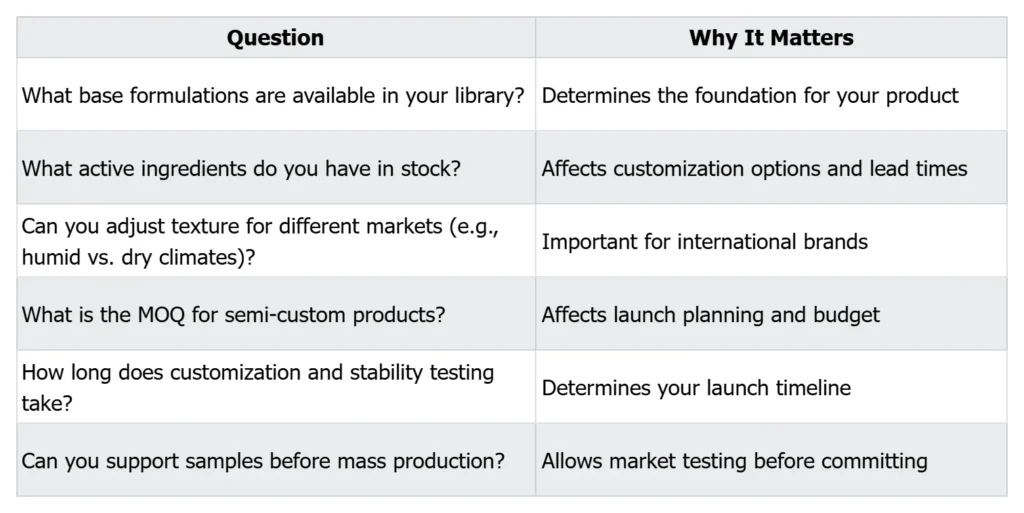
Fir Beauty offers transparent answers to all these questions, with our dedicated account managers guiding brands through each step of the semi-custom process.
Conclusion
Semi-custom formulation represents a strategic middle ground for private label brands seeking premium positioning without the cost and timeline of full custom OEM or ODM R&D. By leveraging proven bases, selecting hero ingredients that tell a brand’s story, and partnering with a manufacturer that offers flexibility and support, brands can launch distinctive, high-quality products with confidence.
Explore custom order options → to see how semi-custom works in practice.
Learn how packaging choices → contribute to premium perception.
Contact our team → to discuss your semi-custom project.
Return to the main guide on private label premiumization → for a complete strategic overview.