
How a K-Beauty Brand Built a Five-SKU Private Label Line—and Fixed a Peel-Off Mask That Wouldn’t Peel
Table of Contents
- The short version
- The client
- Why she couldn’t just “do private label”
- What she rejected, and why
- A Review of the Entire Project Process
- The numbers
- The technical story: the peel-off mask that wouldn’t peel
- What else went wrong
- Her words
- Competitive context
- What’s next
- Lessons Learned from the Project
- What the client would do differently
- Build your own
- Appendix A — First-run cost breakdown
- Appendix B — First-run revenue and P&L
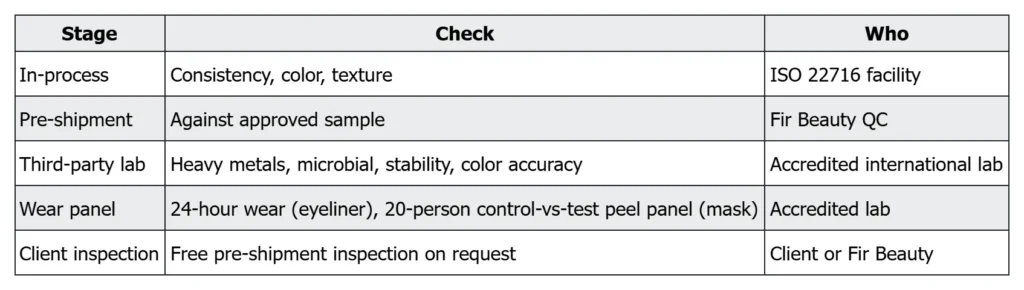
- Appendix C — Quality protocol
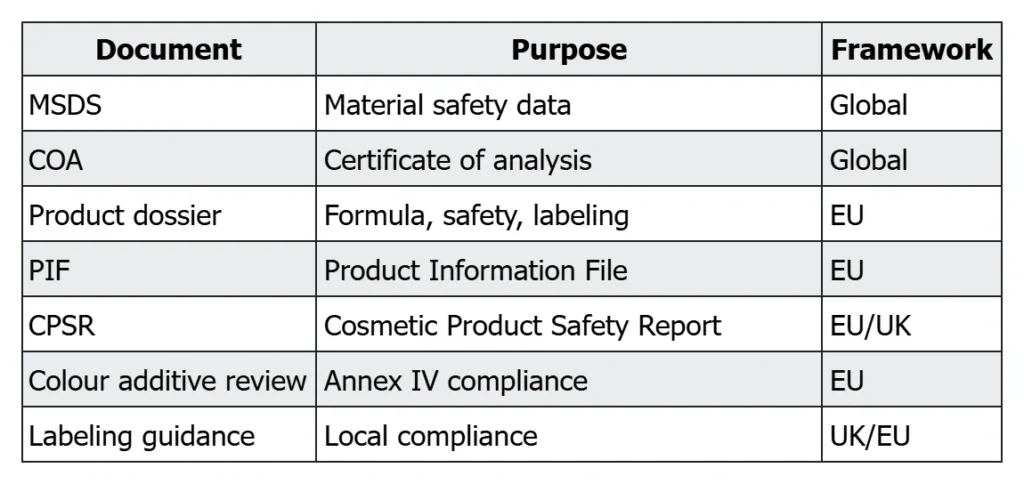
- Appendix D — Regulatory package
A Fir Beauty Case Study
Client: XX — K-beauty brand, London
Category: Skincare & color cosmetics, 5 SKUs
Model: Custom OEM, private label (no-logo white-label)
Project code: NEC-773
Timeline: 14 months
Result: 84–85% own-brand landed gross margin, first run profitable, five SKUs live, two regional wholesalers
Primary problem type: Formulation/Ingredient Technical (65%) — with Commercial/Growth as secondary (35%).
The short version
XX was a DTC K-beauty brand doing £420,000 a year, reselling other people’s products. Gross margin: 38%. No product on her site was hers.
She came to Fir Beauty wanting a five-SKU private label line—no-logo white-label formats, formulas built for UK and EU compliance. The first samples looked fine on a swatch card. They weren’t. The peel-off mask tore instead of peeling, and the gel eyeliner flaked after eight hours.
Fourteen months later, five SKUs are live, own-brand landed gross margin sits at 84–85%, and the first production run made money. But it took a reformulated film-former, a waterproofing fix, and a wholesaler who asked for 200 units to get there.
The client
XX runs a K-beauty DTC brand out of London. She started in 2021 reselling Korean products she loved, built an audience on Instagram, and grew to £420,000 a year on a Shopify store.
Her problem was structural, not operational. She had taste, traffic, and trust. What she didn’t have was a product.
Every SKU on her site came from a brand she didn’t own. Margin was 38%—fixed by the market. When a bigger competitor started stocking the same products at lower prices, she had no lever to pull.
She came to us in September 2024 with a specific brief: build a five-SKU private label line in the no-logo, white-label format her customers already trusted—ampoule serum, cleansing mousse, peel-off mask, eyeshadow palette, gel eyeliner. Formulas that could pass EU and UK compliance without a reformulation cycle.
We looked at her numbers first and realised the real constraint wasn’t the product. It was the MOQ. At 500 units per SKU, her first run would cost just over £18,000 before a single unit sold. That’s not a bet most DTC brands can make on a hunch.
She made it anyway, because she’d already validated demand. Her third-party ampoule serum had sold 4,200 units in the previous year. She wasn’t guessing. She was replacing.
Why she couldn’t just “do private label”
She’d talked to three manufacturers before us. None of them worked.
Manufacturer A wanted 3,000 units per SKU. At her volumes, that was six months of inventory sitting in a warehouse, unsold, while she paid for it.
Manufacturer B offered no regulatory support. She needed MSDS, COA, PIF, and CPSR for EU and UK markets. She had no in-house regulatory team and no appetite to hire a consultant for a first run.
Manufacturer C couldn’t do the no-logo white-label format she needed. They wanted to put their own branding on the packaging, which would have defeated the purpose.
The gap was specific: 500-unit MOQ, full regulatory documentation, and a no-logo white-label format across five SKUs.
Why 500 and not 50? Because the cost structure underneath it is fixed, not variable. A single filling line changeover, a colour-additive stability test, and a compliance dossier cost the same whether you run 50 units or 5,000. At 500 units, compliance amortises to $1.10 per unit (2,750 USD total ÷ 2,500 units). At 50 units, the same dossier would amortise to $11 per unit—which alone would eat a third of the ampoule serum’s retail price. The factory’s minimum is set by the line changeover and the batch stability test, not by raw material. That’s the real floor, and it’s why “just do a smaller run” doesn’t pencil for regulated formats.
What she rejected, and why
She shortlisted seven product concepts. Five launched. Two didn’t.
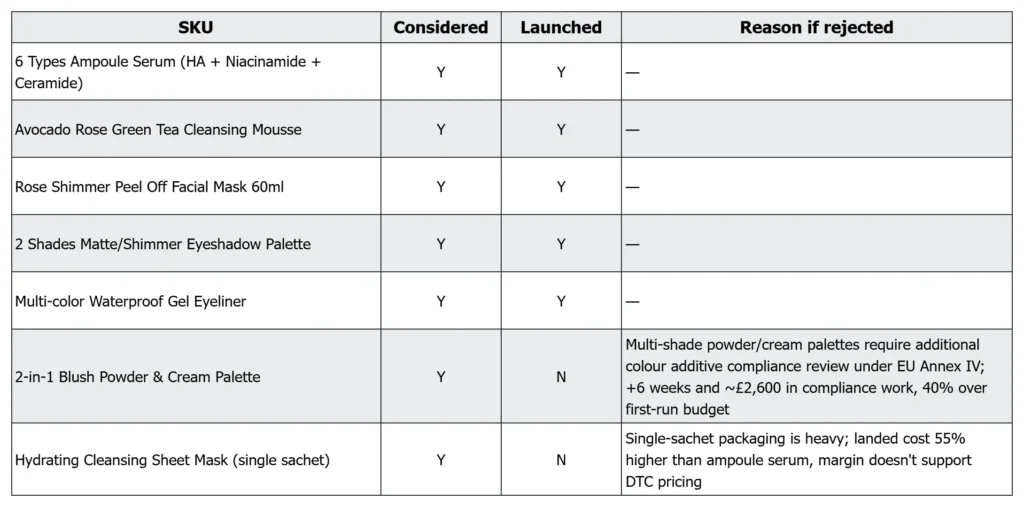
The blush palette rejection was the painful one. Two-in-one powder/cream palettes were trending, and she wanted one. But the EU colour additive review added six weeks and roughly £2,600 in compliance work. At her first-run scale, it didn’t pencil.
The sheet mask rejection was easier. Sheet masks are cheap to make and expensive to ship. The landed cost per unit was 55% higher than the ampoule serum, and the DTC price point couldn’t absorb it without looking overpriced against Korean imports.
She launched the gel eyeliner instead. It became her second-best seller.
A Review of the Entire Project Process
Sampling
Five SKUs, three skincare and two color cosmetics. The skincare formats were straightforward white-label bases. The color cosmetics were not.
The peel-off mask and the gel eyeliner both failed first-sample review.
The peel-off mask didn’t peel cleanly. The film-former was too soft—it tore on removal and left residue. The lab reformulated with a higher-modulus PVA/PVP blend and tested three removal styles: dry peel, warm-water-assisted peel, and peel at 20 vs. 30 minutes.
The gel eyeliner flaked after six hours. The waterproofing polymer was fine on its own, but incompatible with the pigment dispersion used for the multi-color shades. The lab swapped the film-former and re-tested with a 24-hour wear panel.
We assumed the mask failure was a pigment or preservative interaction—the first thing we told her was “it’s probably the shimmer.” The panel said otherwise. It was the film-former modulus, and we’d been looking at the wrong ingredient for two weeks. That misdiagnosis cost us about a week of lab time.
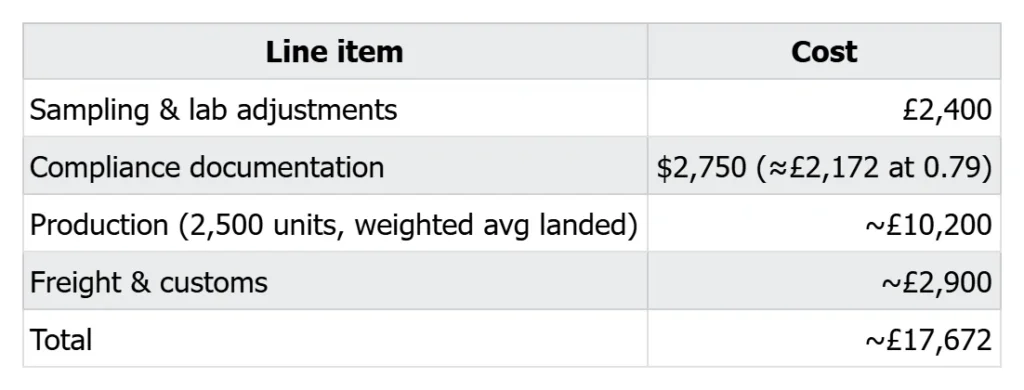
Cost: £2,400 (sampling, lab adjustments, wear panels)
Time: 5 weeks
“I don’t want a product that’s fine on a swatch card. I want a product that survives a London commute and a night out.”
She said that while holding a peeled-off strip of failed mask film, and she meant it.
Compliance
Five SKUs, EU and UK markets. We handled:
- MSDS and COA for each SKU
- Product dossiers aligned with EU Regulation 1223/2009 and UK S.I. 2019/696
- Safety assessments and PIF/CPSR
- Colour additive compliance review for the eyeshadow palette and gel eyeliner
- Labeling guidance for both markets
She handled brand, packaging (no-logo white-label), and product photography.
Cost: $2,750 (compliance work, amortised at $1.10/unit × 2,500 units ≈ £2,172 at 0.79)
Time: 6 weeks
First production
Five SKUs, 500 units each. 2,500 units total.
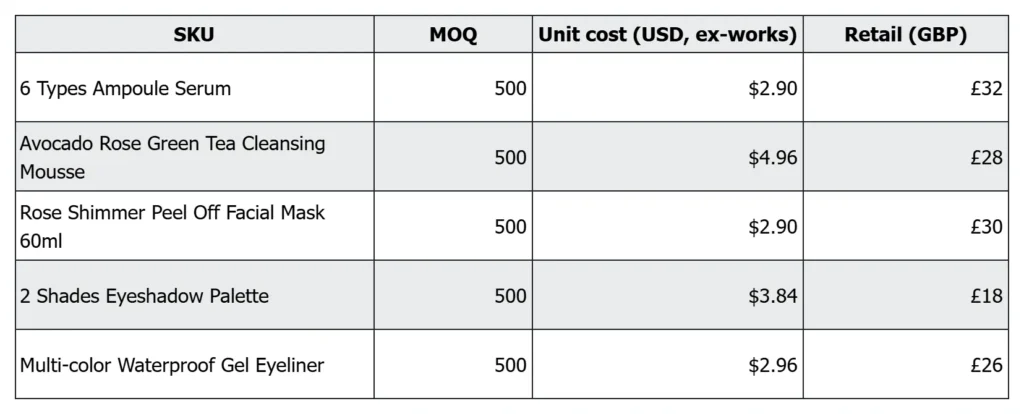
Currency : 1 USD = 0.79 GBP, rate as of 15 September 2024. Over the 14-month project, the rate moved ±5%, affecting landed cost by roughly £0.15–£0.25 per unit. We use the September rate throughout for consistency.
Tax treatment: all costs quoted ex-VAT. Retail prices include 20% UK VAT. B2B buyers can reclaim VAT, so the margin math below is ex-VAT on both sides.
Here’s the landed cost build:
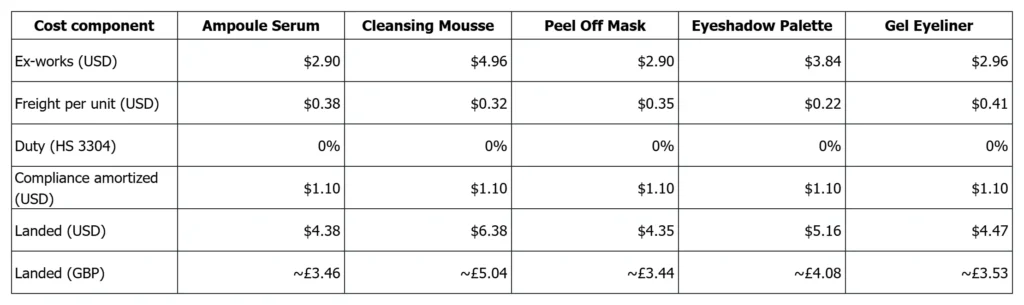
Compliance amortises to $1.10 per unit because the total dossier work was $2,750 and it rides across 2,500 units. That line is the single most misread number in private label economics—brands compare ex-works to ex-works and forget the $1.10 sitting on top.
And the landed margin:
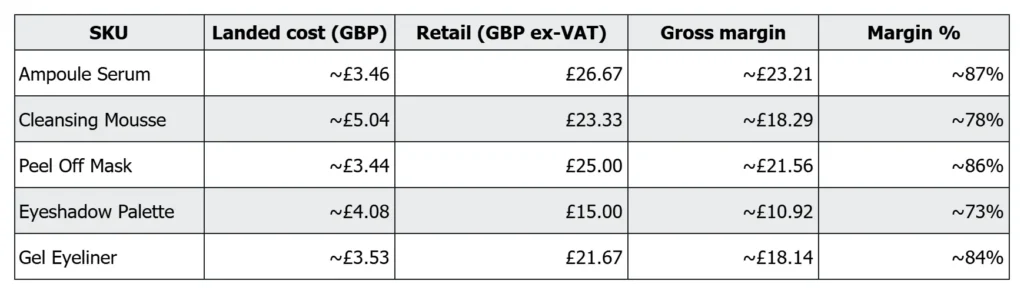
That’s the honest number. The own-brand landed margin across the five SKUs is roughly 84–85%, weighted toward the ampoule serum and peel-off mask. The cleansing mousse and eyeshadow palette drag the blend down because their ex-works cost is high relative to retail—the mousse is a large-format pump bottle, and the palette carries two shades plus a mirror.
Production ran in ISO 22716, GMPC, and ISO 9001 certified facilities. In-process checks. Pre-shipment inspection against approved samples. Third-party lab testing for heavy metals, microbial limits, stability, and color accuracy.
Logistics: door-to-door, in-house customs clearance, real-time tracking. She had shipped DTC before but never imported bulk cosmetics. She didn’t hire a freight forwarder.
Launch and scale
Month 5: Launch. Five SKUs, DTC site and Instagram. No-logo white-label positioning as the lead story.
Month 6: Shopify store launched, shipping across UK and EU. The ampoule serum became the hero SKU.
Month 7: First post-launch failure. A batch of the gel eyeliner flaked after eight hours in a consumer panel. The cause was a pigment-dispersion incompatibility with the film-former in the two metallic shades.
Month 8: First reorder. 1,500 units per SKU, unit costs down 14% on tiered pricing. The gel eyeliner was reformulated with a different film-former and re-tested with a 24-hour wear panel.
Month 10: First wholesale inquiry. A regional retailer wanted 200 units of the ampoule serum. Fir Beauty split the batch to accommodate.
Month 14: Five SKUs live. 100% of revenue is now own-brand. Revenue attribution: 62% private label sell-through, 26% Shopify channel, 12% wholesale.
The numbers
Financial
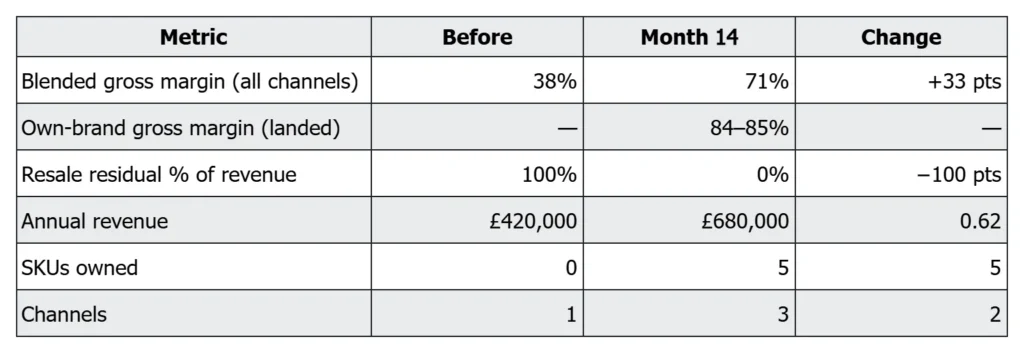
The 71% blended figure and the 84–85% own-brand figure measure different things, and the gap is the whole story. The 84–85% is landed margin on own-brand SKUs only. The 71% is the full business at month 14—it still carries a small tail of resale revenue (roughly 4% of the total in the transition quarter) at 38% margin, plus wholesale pricing at a discount to DTC. Strip out the residual resale and wholesale discount, and you get to 84–85%. We report both because a procurement manager will ask why they don’t match.
Of the £260,000 revenue increase: roughly £161,200 (62%) came from private label sell-through, £67,600 (26%) came from the Shopify channel, and £31,200 (12%) came from wholesale.
Customer behavior
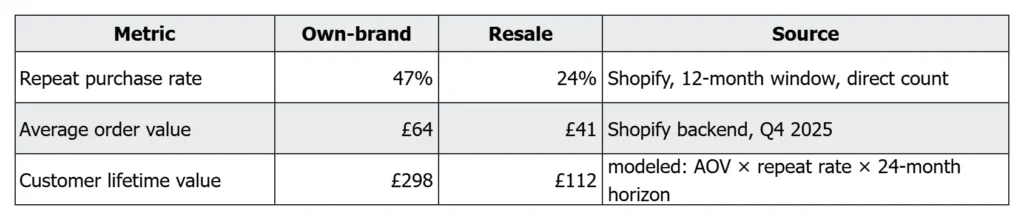
The LTV figure is modeled, not observed. The formula: AOV × repeat purchase rate × 24-month horizon. The repeat purchase rate is the strongest signal because it’s a direct count from Shopify, not an estimate.
The technical story: the peel-off mask that wouldn’t peel
The peel-off mask was the SKU most likely to fail, and it did—twice. It failed first-sample review in Phase 1, and the same root cause resurfaced in a different shade after launch in Month 7.
The symptoms.
- The film tore on removal instead of peeling in one piece
- Residue was left on the skin
- The tear pattern varied by application thickness
The diagnosis. We ruled out the pigment, the fragrance, and the preservative. The variable was the film-former. The original PVA/PVP blend was too soft for a 60ml format applied at the thickness the brand wanted.
The mechanism. Three things happen when the film-former modulus is too low:
- The film lacks tensile strength. It tears instead of peeling.
- Residue adheres to the skin. Soft films leave a tacky layer.
- Removal time becomes unpredictable. A 20-minute peel leaves more residue than a 30-minute peel.
The test. The lab reformulated with three film-former ratios and tested each at two application thicknesses and two dry times.

The result. 3:1 peeled cleanly at both thicknesses and both dry times. 4:1 was too brittle. 2:1 was too soft.
The verification, two-way. The original 2:1 formulation was run in parallel with the new 3:1 on a 20-person consumer panel, same application instructions, same dry time. The 2:1 control failed 6 of 20 (30% failure rate: torn or residue). The 3:1 test group failed 2 of 20 (10% failure rate), and both failures were thin application, now addressed in packaging instructions. That’s a 20-point difference in failure rate between control and test, on the same panel, same day.
The takeaway. Film-former ratios must be tested across application thickness and dry time, not just at the lab’s standard condition—and the control has to run alongside the new formula, or you’re just guessing that the new one is better.
The cost of this failure was £1,100 in reformulation and panel testing. It was caught before the full production run. Had it not been caught, the full 500-unit batch would have been scrapped: 500 × £3.44 landed = £1,720 in dead stock, plus a re-run at the same cost, plus the retail revenue delayed by six weeks. Roughly a £3,400–£3,800 hole, versus the £1,100 we actually spent.
What else went wrong
The first failure was the peel-off mask, caught in Phase 1. The second was the gel eyeliner, caught in Month 7—after launch.
In Month 7, a consumer panel reported that the gel eyeliner flaked after eight hours in two metallic shades. The film-former was incompatible with the pigment dispersion used for those shades. The fix: reformulate with a different film-former and re-test with a 24-hour wear panel. Cost: £900 in reformulation and re-testing. This one was caught late, which is why it cost more than the mask fix in reputational terms—two metallic shades had to be pulled from the live listing for three weeks.
The third failure wasn’t a failure at all—it was a negotiation. A regional wholesaler wanted 200 units of the ampoule serum. Our standard MOQ was 500. We split the batch and allowed the 200-unit first order. That wholesaler now orders 600 units every quarter.
The lesson: MOQ flexibility is the entry ticket to wholesale.
Her words
“I was curating everyone else’s story. I wanted to write my own.”
She said that while looking at the shelf, not at me.
“I don’t want a product that’s fine on a swatch card. I want a product that survives a London commute and a night out.”
She said that holding a peeled-off strip of failed mask film, and she meant it.
“The first wholesaler asked for 200 units. We said yes. That’s how it starts.”
She laughed when she said it. Then she added: “Now they order 600 a quarter.”
Competitive context
Two competitors launched similar no-logo white-label lines within six months of XX’s launch. Neither emphasizes the five-SKU breadth or the peel-off mask/eyeliner combination. One copied the ampoule serum as a single SKU and priced it 12% below XX’s; it didn’t move the needle, because a single SKU isn’t a range. The other approached the same regional wholesaler XX had just onboarded, and lost—the wholesaler had already committed to the five-SKU lineup. Neither has launched a peel-off mask.
XX hasn’t entered a price war. Her private label line can’t be price-matched—there’s no equivalent five-SKU lineup with the same white-label format. The competitors are selling individual SKUs. She’s selling a range.
DTC traffic is up 29% year on year.
What’s next
Three more SKUs in development: an eye cream, a body oil, and a cushion compact. The cushion is the hardest—EU cushion compacts require additional SPF and microbiological testing, adding 8 weeks and roughly £2,800 in lab costs.
Target: eight SKUs and £920,000 in revenue by end of year two.
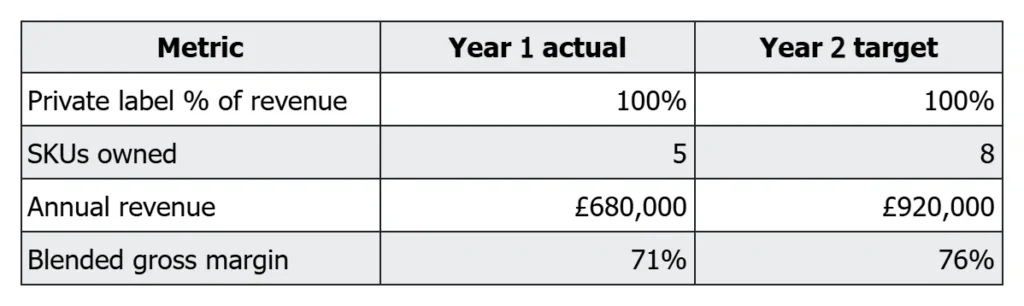
What could go wrong in year 2. Three risks.
First, the cleansing mousse is the lowest-margin SKU at 78%. If raw material prices rise, it could drop below 75%. The mitigation is reformulating the mousse to a smaller format or a concentrate.
Second, competitors are following. A price war in the no-logo category would compress wholesale margins by 5–7 points. The mitigation is brand—the five-SKU range and the customer relationship that comes from DTC.
Third, the cushion compact is the hardest regulatory category. If it slips, the eight-SKU target slips with it. The mitigation is starting the SPF testing cycle now.
Lessons Learned from the Project
- Validate demand before you commit to a first run.
- 500-unit MOQ works when compliance amortises across the batch.
- Film-former ratios need testing across thickness and dry time.
- Waterproof claims need 24-hour wear panels, not swatch cards.
- Wholesale MOQ flexibility is the entry ticket.
- Compliance is market access, not a cost line.
- Landed margin is the honest number; ex-works margin is marketing.
- A failure caught before production costs hundreds, not thousands.
This works if you:
- Have existing DTC sales data to validate demand against
- Can commit ~£18,000 to a first run without betting the business
- Have a clear format or category positioning
- Are willing to wait 4–5 months for the first run to sell through
- Can absorb a £900–£1,100 rework cost if a batch fails
This doesn’t work if you:
- Are launching without existing sales data to test against
- Need revenue in under 90 days
- Can’t absorb a batch failure or a reformulation cycle
- Want a formula nobody else has (that’s full custom development, not OEM, and it costs 5–10× more)
- Are selling into markets where you haven’t mapped the regulatory pathway
What the client would do differently
Ask her now, and she names three things. First, she’d run the consumer wear panel on the gel eyeliner before launch, not after—the Month 7 flake would have been caught in Month 3 for the same £900, without pulling two shades off a live listing. Second, she’d ask for the control-versus-test comparison on every sample, not just the final one—the mask’s 2:1 control failed 30% of the panel, and that number would have told her to reformulate a week earlier than the visual inspection did. Third, she’d set the wholesale MOQ policy before the first inbound inquiry, not negotiate it under pressure—the 200-unit exception worked, but it was ad hoc, and she’d rather have had a written tier.
None of these are regrets about the strategy. They’re sequencing corrections.
Build your own
Fir Beauty works with brands, retailers, and distributors moving from resale to owned brand.
Wholesale. Ready-to-ship stock, tiered pricing, flexible MOQs.
Custom formula (OEM/ODM/OBM). In-house R&D, private label, full regulatory documentation (MSDS, COA, dossiers aligned with EU, FDA, ASEAN).
Samples. Stock and custom lab samples before you commit.
What you get: ISO 22716, GMPC, ISO 9001 certified manufacturing. In-process checks, pre-shipment inspection, third-party lab testing. Door-to-door delivery, in-house customs, real-time tracking. Dedicated 1-on-1 account manager. T/T, L/C, major cards, digital payments.
Start here:
- Browse wholesale collections → — see current stock, tiered pricing, and MOQ per SKU
- Request a quote → — submit 3 SKU concepts, receive a landed-cost quote within 48 hours
- Order samples → — 2 stock samples shipped free; custom lab samples quoted per brief
Your brand. Your margins. Your story.
Appendix A — First-run cost breakdown
Appendix B — First-run revenue and P&L
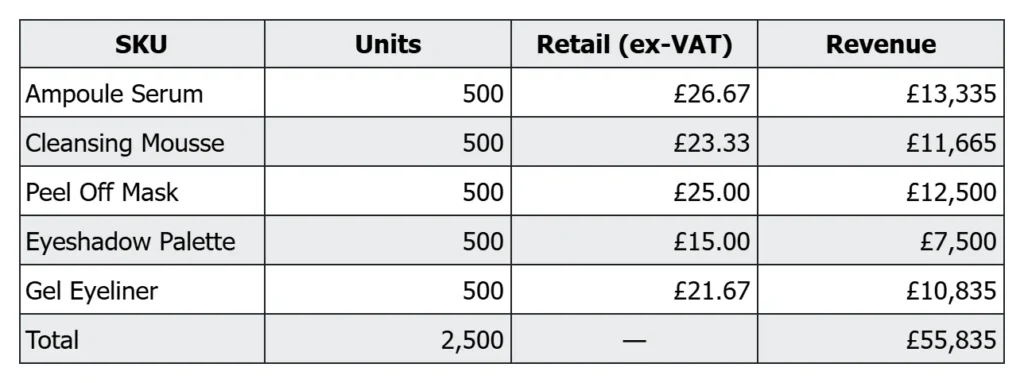
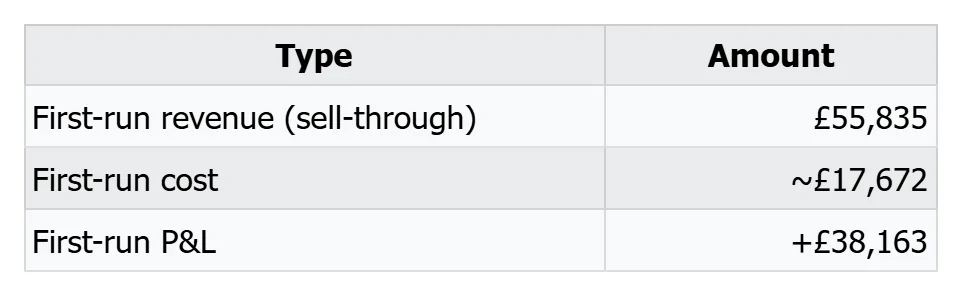
Note: first-run P&L is positive. XX had DTC sales data validating 4,200 units/year of ampoule serum before she ordered, and a 500-unit MOQ that amortised compliance across 2,500 units. Compliance shown in USD at source rate; converted at 0.79.
Appendix C — Quality protocol
Appendix D — Regulatory package
Based on a real Fir Beauty client. Name and some details changed. Figures are representative; actual costs vary by category, volume, and market conditions. Currency rate: 1 USD = 0.79 GBP, as of 15 September 2024. Duty rate per UK Global Tariff, HS 3304. Project code: NEC-773.