
The Art of Premiumization: Achieving High Value Without Fully Custom Formulations
Table of Contents
- Introduction
- Understanding the Nuances of Premium Positioning
- Leveraging Advanced Base Formulations for a Strong Start
- Strategic Ingredient Augmentation: The Customization Edge
- The Critical Role of Packaging, Presentation, and Sensory Experience
- Crafting Perception Through Brand Storytelling and Marketing
- Ensuring Quality Control and Regulatory Compliance
- A Holistic Approach to Premiumization
- About Fir Beauty
How smart private label brands elevate their offerings through strategic choices in bases, ingredients, packaging, and storytelling—without the cost and timeline of full custom OEM or ODM R&D.
Introduction
The beauty industry is witnessing a structural transformation. As the global skincare market continues its upward trajectory, driven by a “prevention-first” consumer mindset, a widening gap has emerged between a high-velocity, innovation-driven premium segment and a value-focused mass market. For private label brands, this presents both a challenge and an opportunity.
The traditional assumption has been that premium positioning requires fully custom OEM or ODM formulations—months of R&D, significant capital investment, and specialized expertise. But that’s no longer the only path. The art of premiumization lies in strategic choices: starting with advanced base formulations, augmenting with hero ingredients, elevating packaging and sensory experience, and crafting compelling brand narratives.
This guide explores how private label brands can achieve high-value positioning through semi-custom approaches, practical customization strategies, and a holistic understanding of what “premium” truly means to today’s consumers.
For brands working with Fir Beauty, this semi-custom pathway begins with access to stability-verified bases and premium active ingredients, enabling premiumization without the traditional barriers of entry. Whether you’re exploring your first private label line or expanding an existing OEM/ODM portfolio, our team understands that every brand has a unique vision—and we’re here to help you bring it to life efficiently and cost-effectively.
Browse our OEM Customization Guide → for a complete walkthrough of the process.
Understanding the Nuances of Premium Positioning
Before diving into tactics, it’s essential to clarify what premiumization means in the private label context. Premium positioning is not simply a higher price point. It’s a combination of factors that signal quality, efficacy, and desirability to consumers.
What premium consumers value:
- Efficacy and results: Consumers expect products to deliver visible benefits—and they’re willing to pay for formulations backed by credible active ingredients.
- Sensory experience: Texture, scent, and application ritual contribute significantly to the perceived value of a product.
- Brand narrative: A compelling story that connects the product to a lifestyle, value system, or aspirational identity.
- Packaging quality: The “first touch” experience matters immensely in establishing premium perception.
- Trust and transparency: Consumers increasingly seek brands that are honest about ingredients, sourcing, and safety.
The premiumization logic operates as a price ladder: brands ascend from entry-level to premium by layering value additions—better ingredients, superior packaging, stronger storytelling. Importantly, this ladder can be climbed without reinventing the formula from scratch, whether you’re working with an OEM partner or developing a full ODM project.
Private label’s unique position: Private label has traditionally been associated with value positioning. However, as market dynamics shift, brands have demonstrated that private-label sub-lines can successfully claim premium territory. The key is understanding that premiumization is about perception as much as formulation—and that private label brands are uniquely positioned to deliver premium quality at accessible price points through strategic OEM and ODM manufacturing partnerships.
For private label brands seeking premiumization, the question is not “Can we afford custom OEM R&D?” but rather “How do we make the right strategic choices at every step of the product development journey?”
See real-world examples in our Case Studies →
Leveraging Advanced Base Formulations for a Strong Start
The foundation of any successful private label product is its base formulation. This is where “semi-custom” begins—and where private label brands can achieve significant efficiency without sacrificing quality.
The Semi-Custom Advantage
Full custom OEM or ODM R&D typically requires 12-18 months and significant investment. By contrast, semi-custom approaches leverage stability-verified base formulations that are then modified with specific actives, scents, or textures. This offers a powerful middle ground for private label brands looking to enter the premium space.
This “accelerator” model follows a structured pathway: selecting a base from a proven library, integrating custom actives, conducting targeted stability testing, and moving quickly to production. The time savings are substantial—customization and compatibility testing can be completed in weeks rather than months, making this an ideal approach for brands who want the benefits of OEM customization without the full ODM timeline.
For private label brands working with Fir Beauty, this semi-custom pathway begins with our library of stability-verified bases—formulations that have already passed rigorous microbial, stability, and preservative efficacy testing. This allows brands to select a foundation that aligns with their target texture and efficacy profile, then customize from there.
The underlying base formula often remains the manufacturer’s intellectual property, but the finished SKU profile—the unique combination of base plus actives—belongs to the brand, providing ownership of the final product while keeping costs controlled. This hybrid OEM/ODM approach gives brands the best of both worlds: the stability of proven bases with the distinctiveness of custom development.
What Makes a “Premium” Base
Advanced bases are characterized by:
- Texture sophistication: Gel-cream hybrids, whipped butters, and serum-in-oil emulsions that feel luxurious on application.
- Ingredient quality: High-grade oils, stable emulsification systems, and well-characterized rheological profiles.
- Proven stability: Bases that have passed rigorous stability, microbial, and preservative efficacy testing before customization begins.
Premium base formulations are not just about functionality—they’re about creating a sensory journey from the moment the product touches the skin. The texture should feel indulgent, the absorption seamless, and the after-feel comfortable and non-greasy. These qualities are built into the base, not added later.
Ingredient Sourcing as a Strategic Asset
Premiumization also depends on access to high-quality active ingredients. Private label manufacturers that maintain in-stock inventories of sought-after actives provide a significant advantage. For example,
manufacturers like Fir Beauty stock advanced actives including peptides (GHK-Cu, SNAP-8, Matrixyl 3000), niacinamide, hydrolyzed collagen, and high molecular weight hyaluronic acid, enabling brands to formulate premium products without sourcing each ingredient individually.
This “single partner” advantage is one of the key trends in premium private label manufacturing. When a manufacturer already holds premium raw materials in stock and offers in-house OEM and ODM formulation support, brands benefit from faster development timelines and lower minimum order quantities than would be possible with custom sourcing.
Explore custom order options → for more details on semi-custom development.
Deep dive into the semi-custom playbook →The Semi-Custom Formulation Playbook: Accelerating Your Brand’s Premium Journey
Strategic Ingredient Augmentation: The Customization Edge
If the base is the canvas, active ingredients and customization are what make the artwork stand out. This is where private label brands can carve out distinct market positions through thoughtful ingredient choices.
Hero Ingredients That Tell a Story
The most successful semi-custom formulations are built around what manufacturers call “Marketing Hero” ingredients—actives that communicate efficacy and brand values at a glance.
Peptide complexes: Copper peptides (GHK-Cu) associated with firmer, smoother skin; SNAP-8 for softening expression lines; Matrixyl 3000 for visibly smoother wrinkles; Eyeseryl for reducing under-eye puffiness. Each peptide tells a different story, allowing private label brands to target specific consumer concerns with credible, science-backed claims.
Vitamins and staples: Niacinamide for pore refinement and barrier support; Vitamin C for radiance and antioxidant protection; hydrolyzed collagen as a moisture-binding protein; sodium hyaluronate for surface-level plumping and hydration. These ingredients are well-understood by consumers, making them powerful communication tools.
Fir Beauty maintains in-stock inventories of these premium actives, enabling private label brands to incorporate hero ingredients without the cost and timeline of individual sourcing. This means a brand can decide to add copper peptides to a base moisturizer and have the customized formulation ready for stability testing within weeks, not months—a significant advantage over traditional ODM development cycles.
The “Single Partner” Advantage in Private Label
One of the key trends in premium private label manufacturing is consolidation. Manufacturers now offer end-to-end solutions that allow brands to move from concept to finished, shelf-ready product through a single partner. This model is particularly valuable for private label brands because it reduces complexity, speeds time to market, and ensures consistency.
Fir Beauty offers this end-to-end capability—from OEM formula development and ingredient sourcing to ODM packaging design and global logistics—so brands can focus on building their identity while we handle the production details.
Avoiding the “Generic” Trap
A common risk in private label is creating products that feel generic—indistinguishable from the competition. Strategic ingredient augmentation prevents this. By selecting unique active combinations, proprietary blends, or ingredients with strong consumer resonance, private label brands can create formulations that feel distinct and intentional.
For example, instead of simply offering a “hydrating serum,” a private label brand might combine hyaluronic acid with a specific peptide complex and market it as a “plumping recovery serum.” The base is proven, the actives are targeted, and the positioning is distinct. This is the art of semi-custom premiumization in practice—delivering ODM-level distinctiveness with OEM efficiency.
Browse product categories → to see hero ingredients in action.
Explore our complete guide to hero ingredients →How to Select Hero Ingredients for a Premium Skincare Line
The Critical Role of Packaging, Presentation, and Sensory Experience
In premium beauty, packaging is not just a container—it’s the first touchpoint of the brand experience. As recent innovations demonstrate, packaging can elevate a product from functional to aspirational. For private label brands, packaging is often the most visible differentiator and the most direct way to signal premium positioning.
Packaging Innovations Driving Premium Perception
Sensory-first design: The trend toward “sensory” packaging is reshaping the beauty industry. Brands are adopting soft, rounded silhouettes and intuitive application gestures that transform the beauty ritual into a moment of pleasure.
For private label brands, these sensory-first formats are increasingly accessible through manufacturers who offer flexible packaging options. Fir Beauty offers a range of premium packaging choices—from glass airless systems to monomaterial PET solutions with high PCR content—allowing private label brands to achieve the sensory and sustainable packaging that premium consumers expect without requiring custom tooling or large minimum OEM/ODM orders.
Refillable and sustainable formats: Premium and sustainability are no longer contradictory. Innovations like refillable designs with distinctive opening systems and recyclable plastic casings with PCR capacity are increasingly available. Glass airless packaging systems now include invisible pistons and customizable disc finishes in colored or metallized options.
Gradient effects and visual language: Recent luxury launches demonstrate the power of visual design in premium positioning—gradient lacquer effects, distinctive finishes, and custom color palettes that tell a brand’s story at a glance.
These visual techniques are no longer exclusive to heritage luxury brands. Private label manufacturers with strong OEM and ODM packaging partnerships can offer similar effects that help emerging brands achieve premium visual language without the development costs associated with full custom packaging.
The Investment Case for Premium Packaging
While premium packaging requires higher upfront investment, it pays dividends through:
- Higher perceived value: Premium packaging commands higher price points and reduces price sensitivity.
- Social media appeal: Instagram-worthy packaging drives organic content and amplifies brand reach.
- Brand differentiation: Unique packaging sets a private label brand apart in crowded retail environments.
- Consumer loyalty: The unboxing experience creates emotional connection and encourages repeat purchases.
Crafting Perception Through Brand Storytelling and Marketing
Even the most advanced formulation and beautiful packaging can fail without a compelling narrative that connects with consumers. This is where brand building meets premiumization, and where private label brands can truly differentiate themselves.
The Brand Story as Premiumization Engine
A premium brand tells a story that goes beyond the product itself. It explains why the product exists, who it’s for, and what values it represents. Consumers increasingly reward brands with:
- Transparency: Clear communication about ingredient sourcing, formulation choices, and manufacturing standards.
- Purpose: A connection to a larger mission or value system.
- Authenticity: A narrative that feels genuine and consistent across all touchpoints.
For private label brands, the brand story is particularly important because it compensates for the lack of heritage that many direct-to-consumer brands can leverage. A well-crafted story builds emotional connection and trust, allowing the brand to command premium pricing.
Communicating the “Semi-Custom” Story
For private label brands, the story is not about “we made this from scratch”—it’s about “we chose the best possible foundation and enhanced it with the ingredients that matter most to you.” This is a compelling and credible narrative that acknowledges the OEM/ODM manufacturing partnership while asserting brand distinctiveness.
Brands can differentiate by highlighting:
- The sourcing story: Where key ingredients come from, why they were selected, what makes them exceptional.
- The formulation philosophy: The principles guiding product development—”clean,” “science-backed,” “minimalist,” etc.
- The brand promise: What consumers can expect from using the product, framed as a benefit rather than a feature list.
Fir Beauty supports private label brands in this effort by providing full regulatory documentation—MSDS, COA, product dossiers—aligned with EU, FDA, ASEAN, and other major frameworks, enabling brands to make credible premium claims with confidence.
Contact our team → to discuss your brand story and compliance needs.
Read the full 2026 packaging guide →The 2026 Guide to Sensory Packaging for Private Label Beauty Brands
Ensuring Quality Control and Regulatory Compliance
No discussion of premiumization is complete without addressing the foundation upon which all premium claims rest: uncompromising quality and regulatory adherence. For private label brands, this is often the most underestimated aspect of premiumization—yet it’s the one that can make or break a brand’s reputation.
The Business Case for Quality
Quality control is not just a regulatory requirement—it’s a competitive advantage. Premium brands command premium prices because consumers trust their quality. A single quality failure can undo years of brand building.
For private label brands, the lesson is clear: quality cannot be delegated entirely to the manufacturer. The brand owner must maintain oversight and accountability for product quality, whether working through an OEM or ODM arrangement.
Maintaining Quality in Semi-Custom Models
When using the semi-custom approach, quality assurance requires:
Clear accountability: As the brand owner placing the product on the market under its own name, you are typically the legally accountable party. This is true even when using a contract OEM or ODM manufacturing organization for part or all of production.
Documented testing: Finished product testing must be conducted under the brand name, not just on theoretical formulations. Safety assessments, microbial stability, and challenge testing must reflect the actual product on the market.
Traceability: Technical documentation, product notification, and labeling must be maintained with full traceability to the actual SKU—not recycled from other brands or formulations.
Leveraging Compliance as a Premium Signal
Many low-cost providers offer “template” safety assessments with insufficient testing and unverifiable supplier documents. These may allow for regulatory submission but fail under authority audits, exposing brands to recall orders, fines, and reputational damage.
Premium private label brands invest in robust compliance: full ingredient percentages, raw material safety data sheets, microbial and stability testing, batch production specifications, and safety assessments authored by certified professionals. This investment not only protects against regulatory risk but also signals quality to consumers, retailers, and distributors.
Fir Beauty operates in ISO 22716 (Cosmetics GMP) certified facilities, with in-process checks, pre-shipment inspections, and third-party testing by accredited international labs covering heavy metals, microbial limits, stability, and color accuracy. Before any bulk shipment leaves our dock, brands can request a free pre-shipment inspection against their approved sample—products are only dispatched when everything matches.
See real-world examples of our quality standards in Case Studies →
A Holistic Approach to Premiumization
The art of premiumization in private label skincare is not about a single dramatic change—it’s about multiple strategic choices that together create a perception of high value.
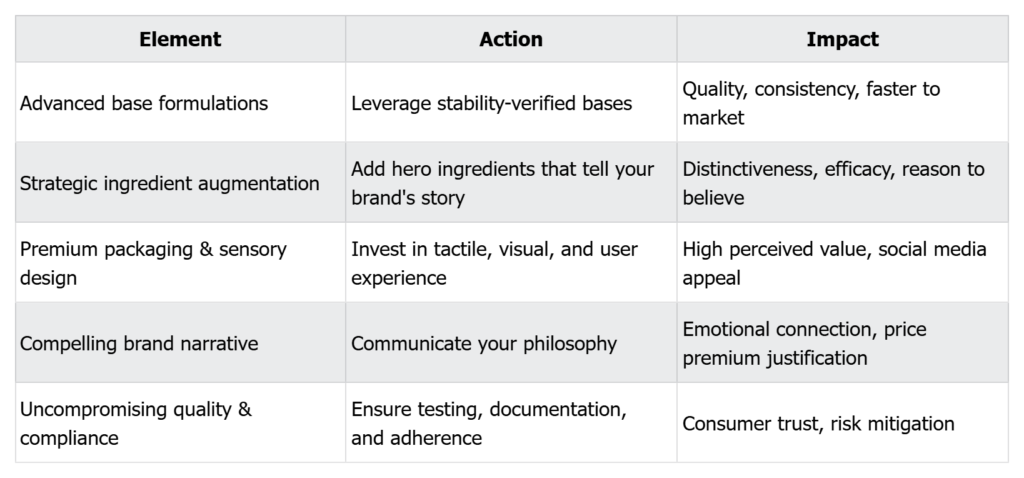
The brands that will succeed in the evolving beauty market are those that understand that premiumization is a holistic endeavor—not just better ingredients, not just nicer packaging, but a coherent integration of formulation, design, storytelling, and quality assurance.
Private label manufacturers that offer semi-custom pathways—stability-verified bases, in-stock premium actives, formulation support, and packaged regulatory services—make this holistic premiumization accessible to brands of all sizes. Fir Beauty’s end-to-end OEM and ODM capabilities provide private label brands with the foundation they need to build premium products with confidence.
The opportunity is clear: With the right OEM or ODM partner and the right strategy, any private label brand can achieve premium positioning without the timeline and cost of full custom R&D.
Ready to elevate your private label offerings? Fir Beauty offers wholesale, custom OEM formula, full ODM development, and sample options. Request a free consultation with our team to identify the best premiumization path for your brand—whether it’s semi-custom formulation, packaging upgrade, or full custom OEM/ODM development.
Start your journey with our OEM Customization Guide →
Browse product categories → to explore our range.
Contact our team → to start your premiumization journey.
Learn how compliance becomes a competitive advantage →Compliance as a Competitive Advantage: Quality & Safety in Private Label
About Fir Beauty
Fir Beauty is your dedicated B2B partner for cosmetics and personal care wholesale, serving brands and distributors who demand quality, flexibility, and end-to-end support. We bridge ambitious beauty businesses with world-class manufacturing, offering:
- Certified manufacturing in ISO 22716, GMPC, and ISO 9001 facilities
- Semi-custom formulation with stability-verified bases and in-stock premium actives
- Full OEM and ODM capabilities from concept to shelf-ready product
- Flexible packaging options from standard premium formats to bespoke designs
- Regulatory documentation aligned with EU, FDA, ASEAN, and other major frameworks
- Global logistics with door-to-door delivery, customs clearance, and real-time tracking
- 1-on-1 account management and 24/7 support
Whether you’re launching your first product line through private label or expanding an existing OEM/ODM portfolio, Fir Beauty provides the infrastructure and expertise to help you achieve premium positioning without the traditional barriers to entry.