
How a One-Person Esthetician Studio Adds a Retail Line Without Adding a Store
Table of Contents
- What a One-Person Studio Sells After the Appointment
- The Three Levels, and Why a One-Person Studio Starts at the Middle
- The First Month, Week by Week
- The Starter Range, Mapped to the Menu
- The Comparison, and the Number That Doesn’t Show Up in It
- Three Questions the Esthetician Will Ask
- Mistakes Worth Avoiding
- Where Firbeauty Fits
Meta description: Ishma Skin Care runs five facials from $50 to $100 and a full waxing menu. What it doesn’t have is a product the client takes home. The first SKU isn’t a serum—it’s aftercare.
Ishma Skin Care, LLC. sits at 1539 Amberly Forest Road, Suite D, in Virginia Beach. The site is built on GoDaddy, and the first thing you see is a stock photo of a treatment room, the line “We Provide Quality Skin Care,” and a Book Online button that leads to a Contact Us page. There’s a phone number, (978) 760-7730, and a Photo Gallery with a carousel of treatment-room images.
The menu is where the studio becomes specific. Under Facial: Signature Facial 60 min at $80, Basic Facial 30 min at $50, Anti Aging 65 min at $90, Acne Facial 65 min at $90, Microdermabrasion 65 min at $100. Under Services: Eyebrow Tinting at $20, Eyelashes Tinting at $30, Brow/Lashes Tint at $45, Brow/Lashes Tint with eyebrow wax at $50, Brow Tint with eyebrow wax at $30. Under Waxing: Eye Brow $15, Eye Brow and Upper Lip $20, Chin $15, Full Face $35, Under Arm $30, Full Arm $50, Stomach $25, Bikini $35, Brazilian $65, Full Leg $60, Half Leg $30.
That’s a real menu. It’s also a menu with no shelf behind it. There’s no product page, no cart, no gift card, no package bundle. The About Us section says the studio will “customize and design our treatments to suit your needs” and that “quality should never be a compromise.” Both are true of the service. Neither has been extended into a product.
What a One-Person Studio Sells After the Appointment
A multi-service spa can afford to think about retail as a second business. A one-person studio can’t. The esthetician is the front desk, the treatment room, the booking system, and the person who answers the phone. Adding a retail line sounds like adding a fourth job.
But the menu already creates the window. A Signature Facial at $80 ends with the client’s skin in a specific state: cleaned, exfoliated, moisturized, and more receptive than it was an hour earlier. An Anti Aging Facial at $90 ends with a similar state but a different priority. An Acne Facial at $90 ends with the skin calmer but still reactive. A Microdermabrasion at $100 ends with the surface worked and the barrier temporarily more sensitive. A Brazilian at $65 ends with a different kind of skin, in a different kind of window.
Each of those endings is a moment when the client is paying attention to what happens next. And each of those moments currently ends with the client walking out the door and solving it themselves, at a drugstore, with a product that has nothing to do with the studio.
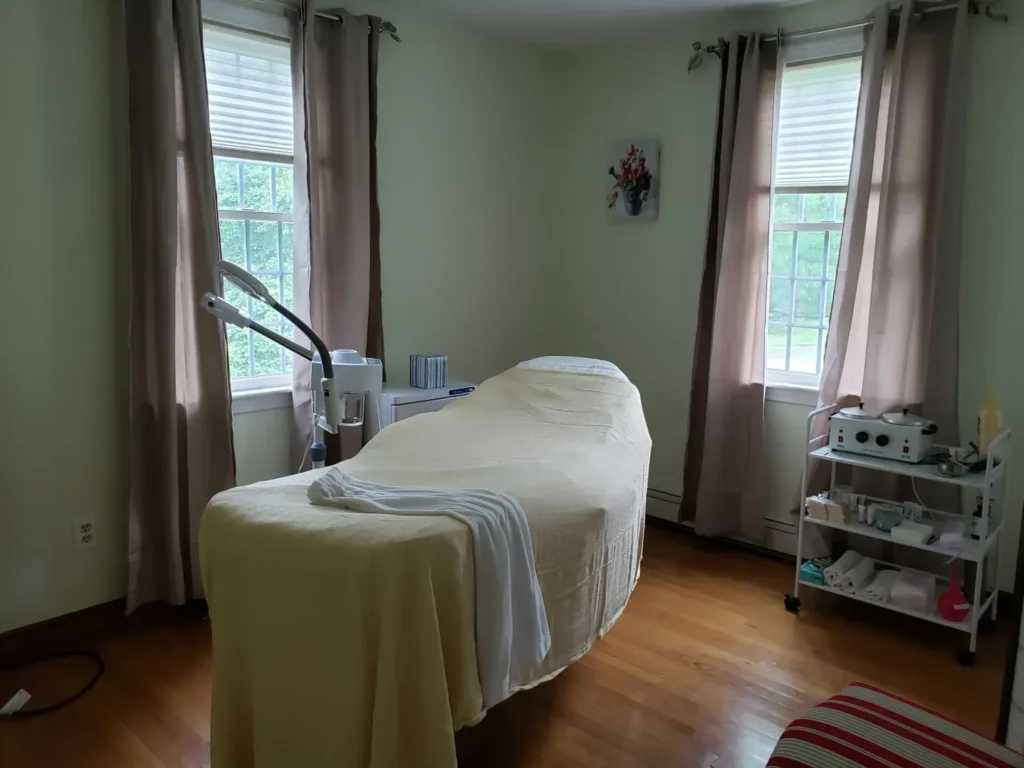
That’s the gap. Not “Ishma doesn’t sell products.” The gap is that the studio’s own menu creates five aftercare windows and none of them has a product with the studio’s name on it.
The Three Levels, and Why a One-Person Studio Starts at the Middle
Most conversations about private label collapse three different things into one word.
Wholesale is buying ready-to-ship product from a supplier at low minimums. It’s the fastest way to put something on a shelf, and it’s the least differentiated. For Ishma, this isn’t relevant. A stock product with the studio’s sticker on it would look exactly like what it is, and the About Us page already promised something more specific than that.
Semi-custom is where the studio’s formula meets a contract manufacturer’s production line. The formula stays the studio’s, the label stays the studio’s, and the manufacturer handles filling and batch records. A 50-piece run per SKU is realistic at this level. For a one-person studio, this is the only level that makes sense: it doesn’t require inventory space, it doesn’t require a second business, and it produces a product that is genuinely the studio’s rather than a relabel.
Full custom is where the formula is adjusted for a specific channel or a specific service window. A post-microdermabrasion balm with a different melt point than a post-facial moisturizer is full custom. It’s the right second step, not the first. A studio that starts here is spending money on formulation before it knows whether the client will buy anything at all.
The order is wholesale, then semi-custom, then full custom. A one-person studio starts at semi-custom, because the formula already exists in the esthetician’s head and the only missing piece is production.
The First Month, Week by Week
The first month isn’t a launch. It’s four small decisions, and each one has a date.
Week 1 — Pick two services, not five. Look at the menu and choose the two services that generate the most “what should I use at home” questions. For most facial studios, that’s the Signature Facial at $80 and the Microdermabrasion at $100, because the first is the volume service and the second is the one with the most obvious aftercare logic. Don’t pick the Acne Facial first, even though it’s the same price as Anti Aging, because acne clients are the most likely to already have a routine they’re loyal to.
Week 2 — Order three pieces of a no-logo sample. Send the supplier the protocol: what the skin looks like at the end of the Signature Facial, what the studio currently tells clients to use, and what clients complain about on day two. Three pieces is enough to compare side by side against whatever the studio currently recommends. Sample turnaround is usually three to five days; anything faster is usually a stock sample, not a match to the studio’s protocol.
Week 3 — Use it in the room, don’t sell it. This is the week most studios get wrong. The sample goes into the treatment room as the finishing step of the Signature Facial, and the client experiences it before anyone asks them to buy anything. No sign at the front desk, no mention of price. The only job this week is to see whether the product feels right on the skin at the end of the service.
Week 4 — Decide on fifty. If the sample held up in the room, the next step is a 50-piece run of one SKU with the studio’s label. If it didn’t hold up, the studio has spent three sample pieces and a week of treatment-room time, and it knows something it didn’t know before. That’s the cheapest possible way to find out whether a retail line is worth pursuing.
The go/no-go standard at Week 4 is simple: did at least three clients ask what the product was, without being prompted? If yes, the 50-piece run is already justified. If no, the product is right but the conversation isn’t happening yet, and the answer is to keep using it in the room for another month before ordering.
The Starter Range, Mapped to the Menu
- Post-facial moisturizer, 50 pieces. The Signature Facial at $80 is the volume service, and it ends with skin that has just been cleaned and moisturized. A lightweight moisturizer that the client can use for the first five nights after the appointment is the simplest first SKU. It’s also the easiest to explain at the front desk, because it’s the product the client just felt on their skin.
- Post-microdermabrasion barrier balm, 50 pieces. Microdermabrasion at $100 ends with the surface worked and the barrier more sensitive. A balm that seals without occluding too heavily, with no fragrance and no exfoliating acid, is the product that matches that window. This is the second SKU, not the first, because the microdermabrasion volume is lower than the Signature Facial volume.
- Post-waxing soothing balm, 50 pieces. The waxing menu runs from Eye Brow at $15 to Brazilian at $65, and every one of those services ends with skin that needs something calming. A single soothing balm that works for both the face and the body covers the whole waxing menu without requiring a separate SKU for each service. This is the SKU that turns a $15 eyebrow wax into a $$15 service plus a$$X product.
- Post-tint brow conditioning oil, 50 pieces. Eyebrow Tinting at $20 and Eyelashes Tinting at $30 are the highest-frequency, lowest-ticket services on the menu. A small brow oil that the client uses for the first week after a tint is a natural add-on, and it’s the product most likely to be repurchased because it runs out quickly.
- Post-Acne Facial gentle cleanser, 50 pieces. The Acne Facial at $90 is the service where clients are most likely to already have a routine, which is why this is the last SKU, not the first. But it’s also the service where a gentle cleanser formulated for reactive skin is the most useful thing the studio can hand over, because it replaces a product the client is probably using wrong.
Five SKUs at 50 pieces each is not a product line. It’s a test of whether the studio’s own menu can support a retail line at all.
The Comparison, and the Number That Doesn’t Show Up in It
| Metric | Today (service only) | With a 50-piece line |
|---|---|---|
| Revenue per visit | Service price only | Service price plus one product |
| Reorder path | None; client solves it at a drugstore | Product runs out, client asks the studio |
| Client recall | Studio name on the receipt | Studio name on the product |
| Upfront risk | None | 50 pieces per SKU |
The table covers the visible numbers. There’s a second number that doesn’t show up in it, and it’s the one that matters for a one-person studio: the number of times a client comes back. A client who buys a post-facial moisturizer and uses it for five nights has a reason to mention it at the next appointment. A client who buys nothing has a reason to forget which studio she went to. For a studio with no front desk and no marketing budget, the product is the only thing that stays in the client’s bathroom between visits.
How much that adds depends on how many Signature Facials the studio runs in a month, and that number is already in the booking system.
Three Questions the Esthetician Will Ask
Will a small batch match the quality my clients expect?
Quality is a specification question, not a volume question. The way to answer it is to compare the three-piece sample against whatever the studio currently recommends, on the variable that matters: how the skin feels four hours after application, not how the product photographs. If the sample feels heavier or lighter than what the studio already hands out, it’s the wrong formula, regardless of the ingredient list.
Will it look like a private label next to the products my clients already use?
This is the packaging question, and for a one-person studio it’s the one most likely to go wrong. The About Us page says the studio will “customize and design our treatments to suit your needs,” and the packaging should reflect that. A small label that says “after your facial” is more consistent with the studio’s voice than a clinical-looking bottle that says “professional-grade serum.” The differentiation is the point, and the differentiation is small.
What do I need before I can hand this to a client?
MSDS, COA, and a product dossier. For a studio that doesn’t have a compliance team, the manufacturer should be able to supply all three without the studio having to ask twice. If the manufacturer can’t show an ISO 22716 certificate, that’s a red flag, not a negotiation point.
Mistakes Worth Avoiding
- Don’t start with five SKUs. Start with one. The Signature Facial at $80 is the volume service, and one post-facial moisturizer is enough to test whether the studio’s clients will buy anything at all. Five SKUs at 50 pieces each is 250 pieces of inventory in a studio that may not have a storage closet.
- Don’t put the product on the website before it’s in the room. Ishma’s site has no cart, and that’s fine. The first 50 pieces should be sold at the end of the appointment, not online. A one-person studio that adds an e-commerce layer before it has a product in the treatment room is solving the wrong problem.
- Don’t pick the Acne Facial first. Acne clients are the most likely to already have a routine they’re loyal to, and the most likely to be skeptical of a new product. The Signature Facial client is the one who is there for maintenance, and maintenance is the easiest retail conversation.
- Don’t let the product replace the conversation. The product is not a substitute for the aftercare instructions the esthetician already gives. It’s the thing the instructions point to. If the client leaves with a product and no explanation, the product becomes a souvenir, not a routine.
Where Firbeauty Fits
This is the part where a supplier usually starts selling. Instead, here’s the practical fit.
Firbeauty is a B2B beauty and personal care supplier and OEM/ODM/OBM manufacturer based in Guangzhou. We work with estheticians, small studios, salons, and skincare brands on color cosmetics, skincare, lip care, and personal care. Our minimum for custom logo and packaging is 50 pieces, and no-logo trials start at three pieces. The factory network is ISO 22716, GMPC, and ISO 9001 certified, and we provide MSDS, COA, and product dossiers aligned with EU, FDA, and ASEAN frameworks. Every project runs on your formulas, your packaging, and your label.
For a one-person studio, the first step is narrow: pick the one service that generates the most aftercare questions, send the protocol to us for a three-piece match, and use it in the room before deciding on fifty. If the match holds, the 50-piece run and the dossier come next.