
In-depth Analysis of the Lip Gloss Category
Table of Contents
- In-depth Analysis of the Lip Gloss Category: From Category Structure to Private Brand Breakthrough Strategies
- I. Category Niche and Strategic Role: What Position Does Lip Gloss Occupy in the Lip Category?
- II. Price Range and Consumer Demographics of the Lip Gloss Category
- III. Functional Buttons and Ingredient Trends: Where is the Competitive Edge of the Lip Gloss Category?
- IV. SKU Mix and Portfolio Strategy: How Can the Lip Gloss Category Drive Profit Through Packaging and Specification Design?
- V. Brand Competition Landscape and Breakthrough Strategies for White-Label Products
- VI. Supply Chain Decision Checklist for Lip Gloss Category
In-depth Analysis of the Lip Gloss Category: From Category Structure to Private Brand Breakthrough Strategies
Amid the category restructuring where lip gloss is losing ground while lip oil is on the rise, lip glaze demonstrates a completely distinct competitive logic: it does not ” market share from lip gloss, but rather acts as an independent category, leveraging the two-dimensional barrier of “long-lasting wear + color payoff” to establish a “fortress category” in the lip product ecosystem — a segment that private labels find hardest to penetrate, yet delivers the thickest profit margins once they break through. This article will provide a complete decision-making framework for the US market from five dimensions: category niche and strategic role, price tier and consumer group, Functional Button and ingredient trends, size range and portfolio strategy, and brand competition landscape.
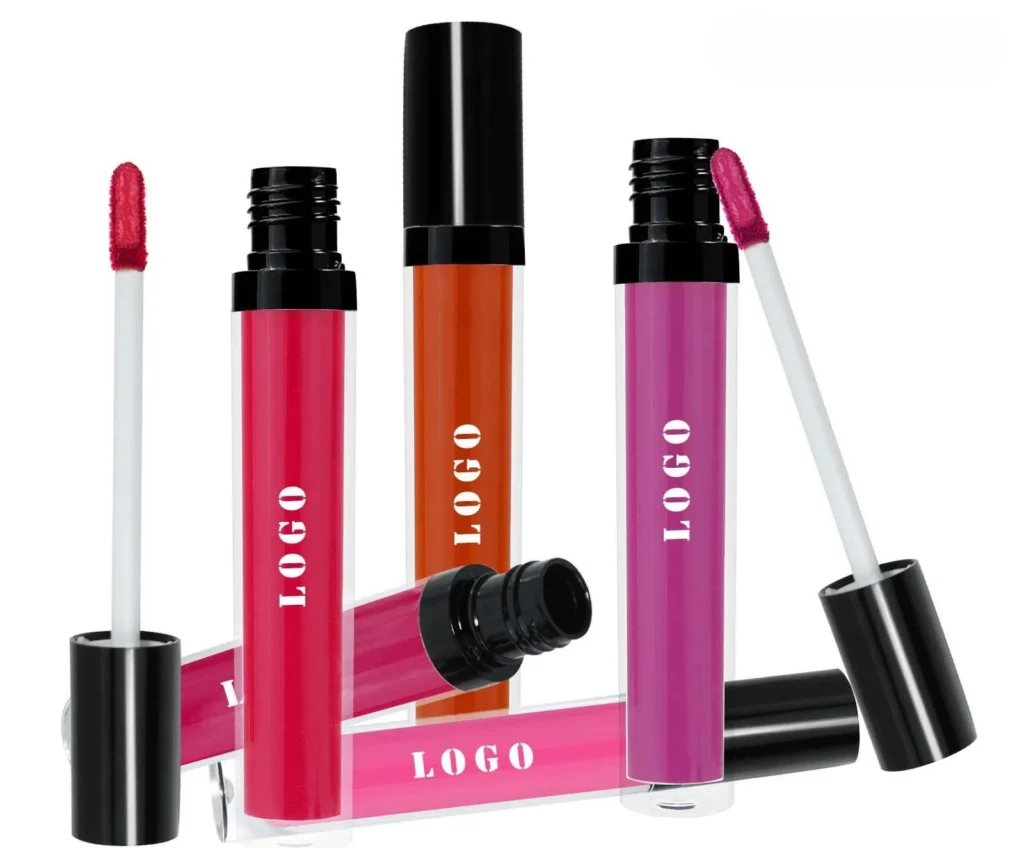
I. Category Niche and Strategic Role: What Position Does Lip Gloss Occupy in the Lip Category?
1.1 Category Scale and Growth Logic
Lip gloss (Lip Stain/Liquid Lipstick) is one of the largest and most structurally stable subcategories in the US lip product market. The North American lip stain market was valued at approximately USD 7.26 billion in 2026, and is projected to reach USD 6.62 billion by 2035 with a compound annual growth rate (CAGR) of 4.09%. Across the entire North American lipstick market, a stark contrast exists between the premium and mass channels: premium lip products account for 15% of total cosmetics retail sales, and are the only category in premium beauty that maintains growth; in the mass channel, lip products are likewise the only cosmetics category that sustains growth.
This means that the growth momentum of the lip glaze category comes from two directions:
- Structural Substitution: With the solid advantage of “long-lasting non-staining on cups”, it continuously captures market share from traditional lipsticks and lip glosses.
1.2 The “Three-Stage Rocket” Role Model for the Lip Gloss Category
Lip gloss plays a vastly different role in the product matrix compared to lip oil: while lip oil mostly serves as a “traffic-driving and growth-driving” category, lip gloss is the core category that underpins profits and brand positioning.
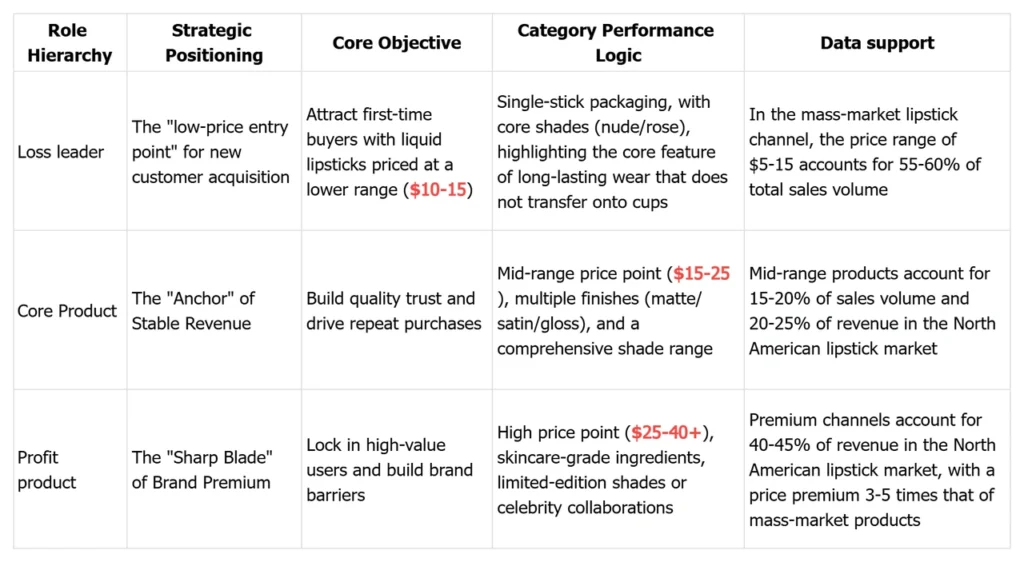
1.3 The Strategic Niche of Lip Glaze: Why Is It the “Hardest Position to Capture”?
Different from the “lightweight alternative” positioning of lip gloss mentioned earlier, the competitive barriers of lip glaze come from three dimensions:

Once consumers find “the right one” for lip gloss (liquid lipstick), their brand loyalty is significantly higher than that for lip oils and lip glosses. This means that private labels face the greatest difficulty in entering the liquid lipstick category, but once they gain a firm foothold, they establish user lock-in in the form of a Competitive Edge.
II. Price Range and Consumer Demographics of the Lip Gloss Category
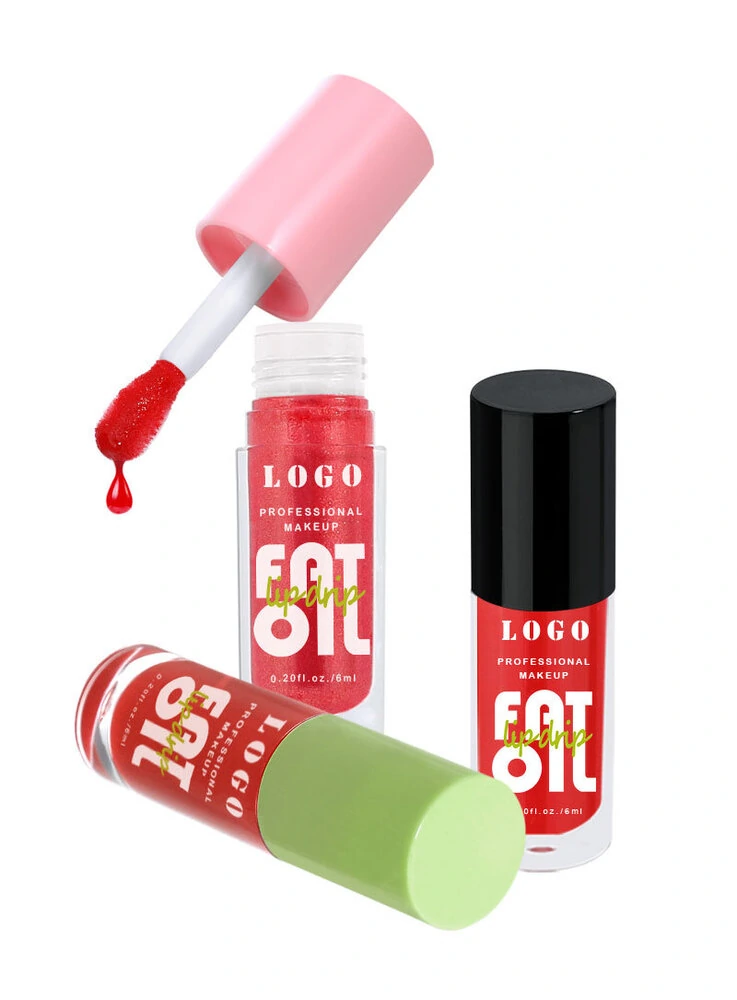
2.1 Price Tier Pyramid of the North American Lip Gloss Market
The price range of the North American lip makeup market presents a typical dumbbell-shaped structure: the mass segment wins by volume, the high-end segment wins by price, and the mid-range segment is being squeezed from both ends, but this instead creates opportunities for private label brands:

2.2 The Correlation Logic Between Pricing Mechanism and Marketing Strategy
The pricing strategy of lip gloss is more complex than that of lip oil, as it is subject to the category attribute that “functional promises must be delivered on”:
The “function verification logic” in the $5-15 range:
- Key Metrics: Number of Reviews > Brand Awareness
- Risks: Consumers inherently lack trust in low-priced lip glosses, with the psychological expectation that “cheap goods are of inferior quality”
- Risks: Consumers inherently lack trust in low-priced lip glosses, with the psychological expectation that “cheap goods are of inferior quality”
The “value verification logic” in the $15-25 range:
- Key Metrics: Re-purchase Rate > Single Conversion Rate
- Opportunity: Consumers in this price range are willing to read product detail pages, making this the optimal price band for private brands to build a “sense of professionalism”.
- Opportunity: Consumers in this price range are willing to read product detail pages, making this the optimal price band for private brands to build a “sense of professionalism”.
Trust verification logic for the $25+ range:
- Key Indicator: Brand Search Volume > Category Search Volume
- Threshold: Sustained marketing investment and consumer education are required
- Threshold: Sustained marketing investment and consumer education are required
III. Functional Buttons and Ingredient Trends: Where is the Competitive Edge of the Lip Gloss Category?
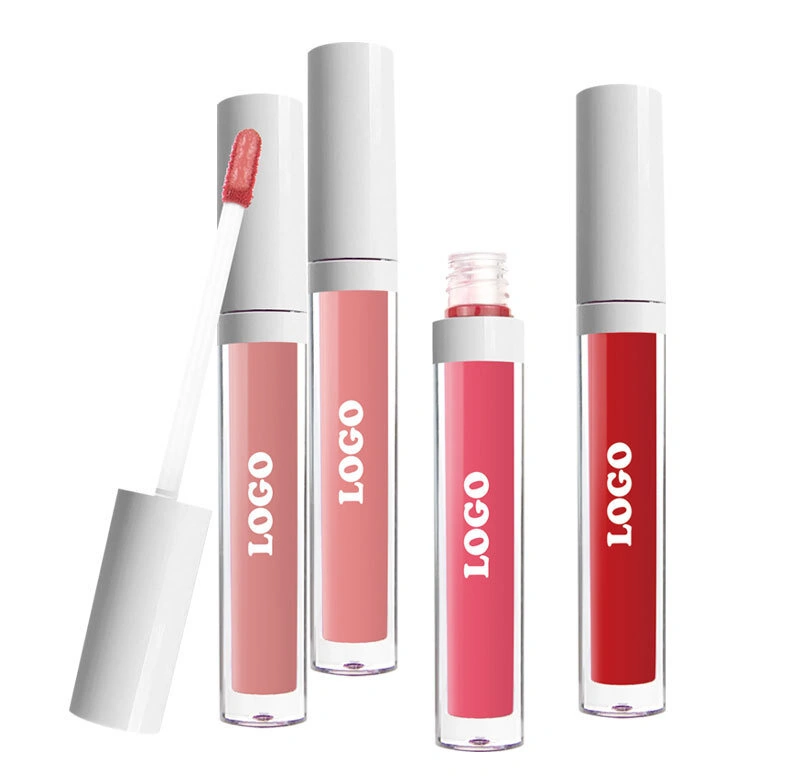
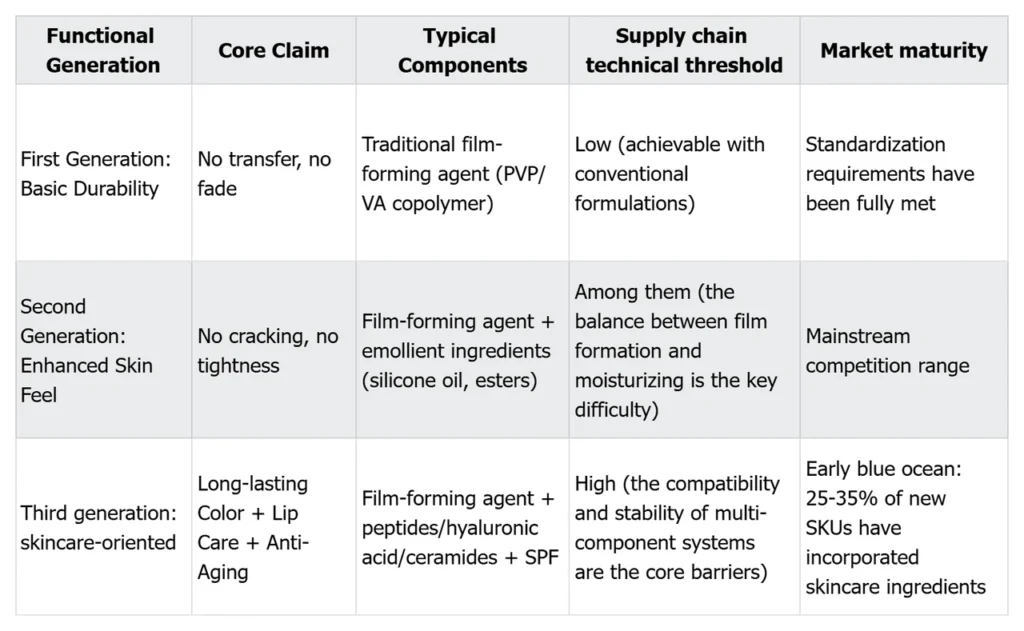
3.1 Functional Evolution Path of Lip Glaze: From “Long-Lasting Color” to “Skincare-Oriented
North America’s lip product category is undergoing a structural transformation towards “skincare-ization”. Consumers no longer tolerate formulas that “sacrifice lip health for color payoff”, and demand lip products that deliver color vibrancy, moisturization, smoothing and repairing effects all at once. The functional evolution path of the lip gloss category is as follows:
3.2 Underlying Drivers of Component Trends
Driver 1: “Skinification” is an irreversible structural trend
The addition of skincare ingredients in lip products has evolved from a marketing concept to a competitive benchmark. In the US color cosmetics market, formulas that integrate skincare benefits (including hyaluronic acid, peptides, niacinamide, and SPF) represent the most significant growth driver. Over 40% of newly launched lip products carry “clean” or “vegan” claims.
Driver 2: “Clean/Pure”(Clean Beauty) Shifts from “Optional” to “Mandatory”
Lip products come into direct contact with the mouth, so consumers are far more sensitive to ingredient safety than they are to facial makeup. Certifications such as organic, vegan, cruelty-free, and paraben-free are becoming the default expectation for consumers. In the lip tint market, clean/pure/vegan formulas have emerged as the key driving force.
Driver 3: “Durability” remains a core focus, yet it is no longer the sole criterion for evaluation
The underlying logic of the lip gloss market remains “long-lasting performance”. However, what consumers demand today is the triple satisfaction of “long-lasting wear + comfort + lip care”. Lip products claiming “moisturizing or caring effects” are growing at a rate of 8-10%, outpacing the 4-6% growth of the overall lip product market.
3.3 Key Points of Formulation Technology for Lip Gloss Category
From the perspective of the supply chain, the technical difficulty in lip glaze formulation lies in the compatibility among the film-forming system, the pigment system and the skincare ingredient system:

When evaluating lip glaze suppliers, private brands should focus on three core technical capabilities:
- Compatibility between Skincare Ingredients and Film-Forming Agents: Can We Achieve “Long-Lasting Effect and Deep Hydration”?
- Cross-skin adaptability in shade development: Can consistent color payoff be achieved across multiple base skin tones?
- Cross-skin adaptability in shade development: Can consistent color payoff be achieved across multiple base skin tones?
IV. SKU Mix and Portfolio Strategy: How Can the Lip Gloss Category Drive Profit Through Packaging and Specification Design?

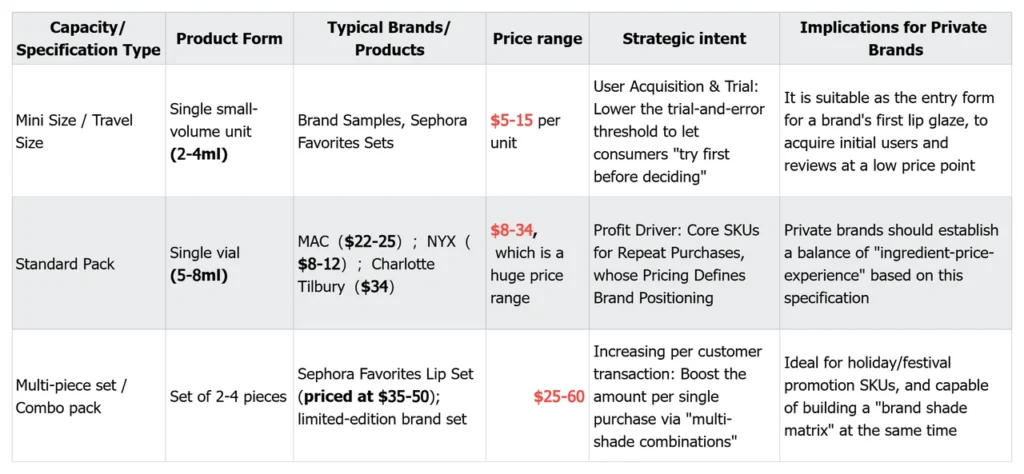
4.1 Mainstream Specifications and Pricing Strategy
The specification strategy of the North American lip gloss market follows a clear path of “trying out new products → building loyalty → stockpiling”:
4.2 Underlying Logic of the Specification Combination Strategy
The lip gloss category faces a core contradiction: the pricing of standard-size units defines a brand’s tier, yet multi-packs are the lever to boost per customer transaction. For private-label brands:
- If the price of the standard pack is higher than $20, the “bundle discount” for multi-packs will be more noticeable to consumers.
Recommended strategy:
Price the standard pack at $18-22 to reflect its value, and meanwhile launch a 2-3 pack bundle priced at $30-40, which creates the perception of “save $10 when buying 2”, so that both “trial users” and “stock-up shoppers” can get what they need.
The lip glaze category has higher requirements for the number of shades than lip oils and tinted lip balms. When purchasing lip glaze, consumers usually expect a sufficient range of shade options. However, the shade planning for private labels should follow the principle of “starting with a focused range of 3-5 shades, then expanding based on data performance later”, so as to avoid the inventory trap of “ordering 20 shades for the first batch, only to find 10 of them are unsalable”.
Recommended shade number strategy:
- Trendy Color Shades (1-2): Determined based on TikTok/social media trends (e. g., “black cherry”, “cool-toned pink”)
- Limited edition color (1, optional): Creates a sense of scarcity and drives social media buzz
- Limited edition color (1, optional): Creates a sense of scarcity and drives social media buzz
V. Brand Competition Landscape and Breakthrough Strategies for White-Label Products

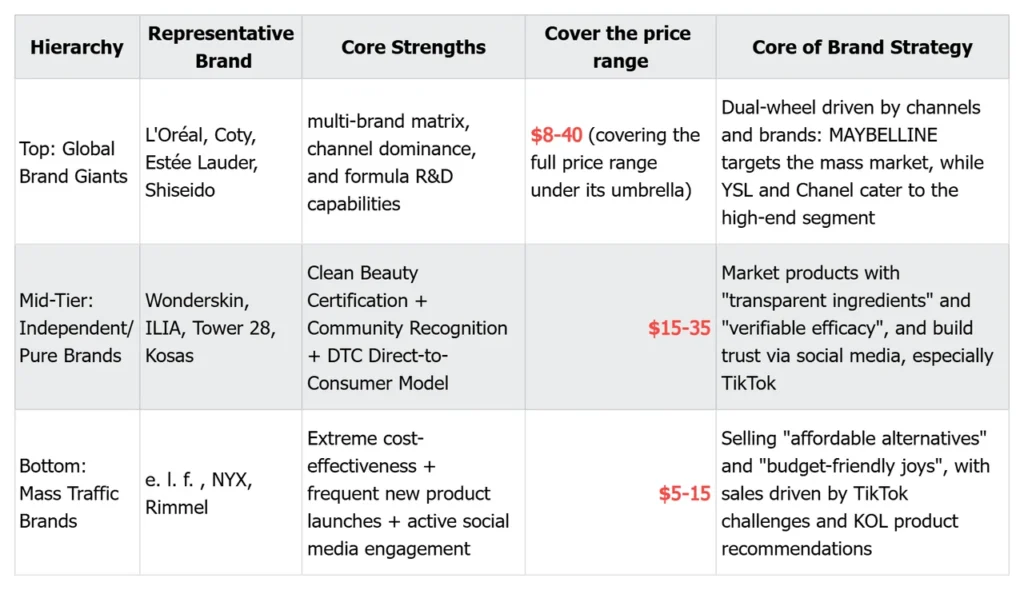
5.1 Current Brand Landscape of the Lip Gloss Category
The brand landscape of the North American lip care market is characterized by “strong players at both ends and fierce competition in the middle”:
5.2 Breakthrough Strategies for Mid-Tier Brands in the Lip Gloss Category
The competitive landscape of the lip gloss category is even harsher than that of lip oil: leading brands have higher channel and brand barriers, yet the two major trends of “skincare-oriented” and “clean beauty” are creating breakthrough opportunities for white-label products.
Strategy 1: Do not aim to be “just another lip gloss”, but rather “a lip gloss with a clear identity label”
The competition in the lip gloss market has gone beyond the basic function of “long-lasting and non-transferable to cups”. The differentiation directions for private brands can include:
- “Clean Beauty” Route: Develop lip glosses that are “vegan, cruelty-free, and formulated with non-controversial ingredients”. Over 40% of new lip care products now carry “clean” claims, and brands that have not yet adopted this label are losing traction among young consumers.
- The “functional verification” route: develop a lip glaze with built-in verification of visual effects. The success of Wonderskin’s peel-off staining lip glaze lies precisely in the fact that the “peel-off” action itself serves as proof of its long-lasting effect.
- The “functional verification” route: develop a lip glaze with built-in verification of visual effects. The success of Wonderskin’s peel-off staining lip glaze lies precisely in the fact that the “peel-off” action itself serves as proof of its long-lasting effect.
Strategy 2: Avoid the “red ocean of mass price ranges” and target the “blue ocean of mid-end value ranges”
The mass price segment ($5-15) is the most fiercely contested zone between leading brands and private labels, with margins squeezed to the absolute limit. Meanwhile, a structural gap is emerging in the mid-range
segment ($15-25): leading brands have set excessively high prices in this bracket, while independent brands are moving upward into the $25+ tier. This very gap represents a prime opportunity for private labels.
Pricing Recommendation: The target retail price is $16-20, and the value perception shall be established by leveraging “a film-forming formula of premium brand level + skincare-grade ingredients + pricing 30% lower than premium brands”.
Strategy 3: Use “multi-packs” and “mini-packs” to lower the trust threshold, and use “standard packs” to build a profit pool
Lip gloss is one of the categories where it is most difficult for private brands to build trust, as consumers naturally doubt whether affordable lip gloss can actually deliver long-lasting effects. Offering mini sizes or sets of 2 to 3 units as a trust-building entry point can reduce consumers’ trial-and-error costs without undermining brand value.
VI. Supply Chain Decision Checklist for Lip Gloss Category
Based on the above analysis, when private label sellers evaluate the lip gloss category and select suppliers, they should focus on the following core issues:
Regarding Category Positioning:
- What is your core shade strategy? Can the first 3 to 5 launched shades cover mainstream demands?
Regarding Price and Profit:
- Have you considered the tiered pricing strategy of “mini-sized trial packs + standard-sized packs for profit + multi-packs to boost per customer transaction”?
Regarding Functions and Ingredients:
- Does your formula meet the market expectations for “clean/pure” products? Has it obtained the corresponding certifications?
Regarding Specifications and Packaging:
- Have you considered using “multi-packs” as a lever to boost per customer transaction?
Regarding supplier capabilities:
- Can the supplier achieve color difference control between batches? Can it adapt to the color rendering differences of lips with different base colors?
- Does the supplier’s MOQ match the scale of your initial order and your tolerance for inventory risk?
- Does the supplier’s MOQ match the scale of your initial order and your tolerance for inventory risk?