
Foundation Base Ingredients: The Silent 90% — The Invisible Force That Defines Foundation Quality
Table of Contents
Original version:
In the analysis of the foundation category, the vast majority of discussions revolve around what active ingredients are added — niacinamide, peptides, hyaluronic acid. .. These ingredients usually account for only 0.1-5% of the formula, and while they do determine the claimed efficacy of the product, they do not determine its fundamental quality.
The base component, which accounts for 70-95% of a foundation formula, is the fundamental factor that determines whether a foundation performs well or not. This article will systematically analyze how this “silent 90%” shapes the quality and competitiveness of foundation from four dimensions: the definition of base components, their essential differences from active ingredients, three major technological innovation directions, and the significance of commercial decision-making.
I. What are base components?
1.1 Definitions and Composition
The basic structure of a foundation formula can be broken down into three parts: base + powder + active ingredients. Among them:
- Base (base component): Accounting for 70-95% of the formula, it consists of aqueous phase components and oils and fats, which determines the product form (such as emulsion, powder, gel, etc.) and basic skin feel
- Powders: including color pigments such as titanium dioxide, iron oxide yellow/red/black, as well as fillers like silica and mica, which determine the makeup finish
- Active ingredient: accounts for 0.1-5% of the formula, delivering the claimed skincare benefits
In the cost structure of a foundation formula, 95% of the cost goes into the base and powders, leaving only around 5% for active ingredients. This means that when the retail price of a foundation is driven down to an extreme, the first thing to get cut corners on is the quality of the base ingredients.
1.2 Essential Difference Between Base Ingredients and Active Ingredients
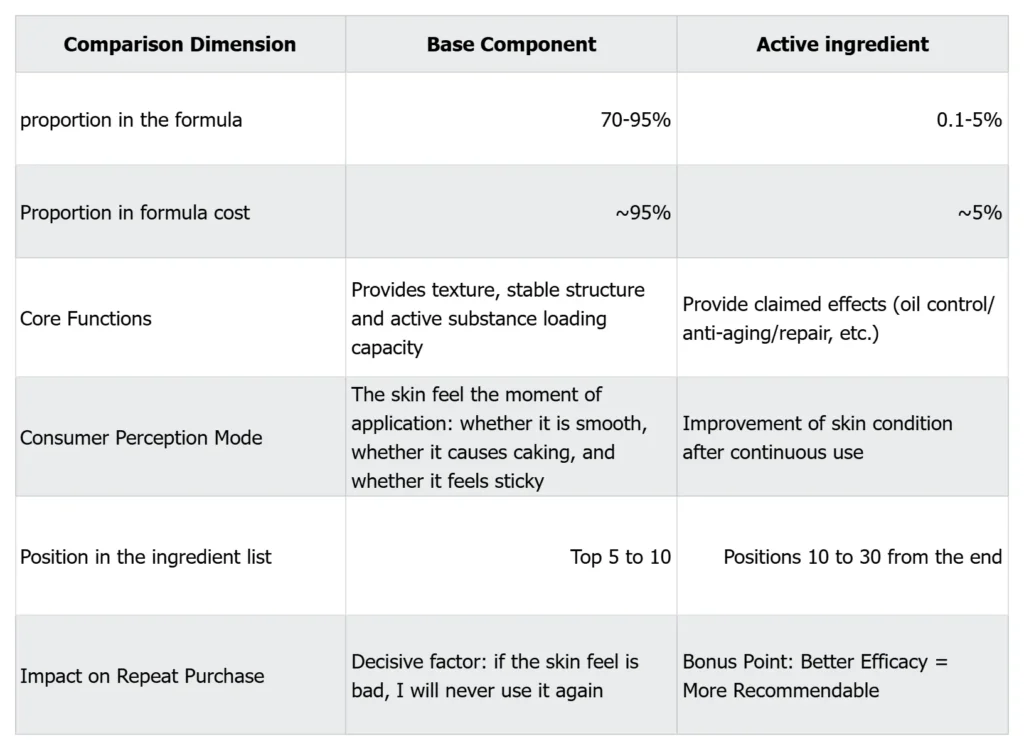
The base formulation determines whether a product performs well, while the active ingredients drive consumers’ willingness to give it a try. The former forms the foundation for repeat purchases, whereas the latter serves as the motivation for an initial purchase.
2. Three Major Technological Innovation Directions for Substrate Components
2.1 Silicone-Free Formulation
Definition: A formulation that does not contain organosilicon compounds (such as decamethylcyclopentasiloxane D5, polydimethylsiloxane).
Why has silicone-free formulation become a trend?
- Driven by the clean beauty trend: some silicone oils (such as D5) have been classified by the EU as substances with potential environmental risks, and consumers place greater trust in silicone-free claims backed by clear standards
- Misconception about skin feel: Some consumers believe that silicone oil causes a slippery false feel and clogs pores, even though scientifically, silicone oil molecules are too large to penetrate pores.
- Brand Differentiation: In terms of clean/pure positioning, “silicone-free” is a claim with higher technical value than “additive-free”
Technical alternative routes for silicone-free formulations:

Example of monetization formula: Azerez’s Flawless Vivid Foundation formula adopts 100% naturally derived water-in-oil emulsifiers and naturally derived amino acid surface-treated pigments, contains no silicone or mineral oil, and delivers a lightweight, non-greasy, adherent and translucent makeup finish.
Formula validation data: COSMAX’s patented technology (US2025/0170032) demonstrates a stable formula that can achieve viscosity stability of 3,000-30,000 cps (Brookfield viscometer, No. 64 rotor, 12rpm, 1 minute, measured at 25 ° C) and hardness of 10-30 dyne/cm ² (CR-3000EX-L hardness tester, No. 9 rotor, 2cm/min speed) without using silicon or PEG-based emulsifiers.If the viscosity is lower than 3,000 cps, the product will have insufficient stability; if it is higher than 30,000 cps, it will be difficult to pump out of the container.
Business Insight: The technical challenge of a silicone-free formula lies in replacing silicone oil with natural oils without compromising the skin feel. If a supplier can provide stability test data for silicone-free foundations (cycling tests at high temperature of 40℃/75%RH and low temperature of -5℃), it indicates that their technical capability has exceeded the industry average.
2.2 Functionalization of Substrate Components
Definition: The base component is no longer merely a carrier, but actively participates in the realization of product efficacy.
Technical Route 1: Replacement of inert oils with functional oils
We select oils with inherent skincare benefits as base ingredients, enabling the skin-feel carrier to also serve as an active contributor to efficacy.
- FANCOR® MEADOWFOAM SEED OIL: Naturally extracted, it features extremely strong antioxidant capacity. When used as a base oil, it not only delivers an excellent skin feel but also contributes antioxidant benefits.
- Acticire® MB: a 100% plant-based texture modifier (a complex of jojoba wax, green acacia flower wax and sunflower seed wax), whose moisturizing and soothing effects have been verified via in vivo testing
Technical Route 2: Functionalized Colorant as a Substitute for Inert Colorant
The color powder is encapsulated with skin care actives to transform it from a pigment into an active ingredient carrier.
- Patented technology (CN111920706A) innovatively adopts the encapsulation technique to fully enclose the concealing color-correcting ingredients (color powder) in the oil phase, which is then thoroughly blended with deep-care essences including nicotinamide, panthenol and betaine, enabling the foundation to deliver triple effects of complexion adjustment, moisturizing and deep nourishment.
- In this patented formula, the first polar oil component (such as propylene glycol dicaprylate/dicaprate, dipentaerythrityl hexacaprylate, etc. , 10-28 parts) and the second polar oil component (such as isononyl isononanoate, etc. , 48-52 parts) together form the oil phase matrix, and the color powder (10-23 parts of titanium dioxide + iron oxide series) is completely encapsulated in the oil phase.
Functionalized substrates differ from products with added active ingredients in that the substrate itself delivers skincare benefits. This positioning boasts a more compelling narrative logic in the clean beauty market.
2.3 Components of Bio-based and Degradable Substrates
Definition: Raw materials derived from renewable biological resources (plants, microorganisms) and degradable in the environment.
Case:

Commercial value of bio-based products: In the US market where there is no unified federal standard for “clean” or “pure” claims, bio-based and degradable claims can provide brands with a more specific and verifiable narrative around Sustainability.
3. The Significance of Base Component in Commercial Decision-Making
3.1 How to Determine the Technical Grade of Base Ingredients via the Ingredient List
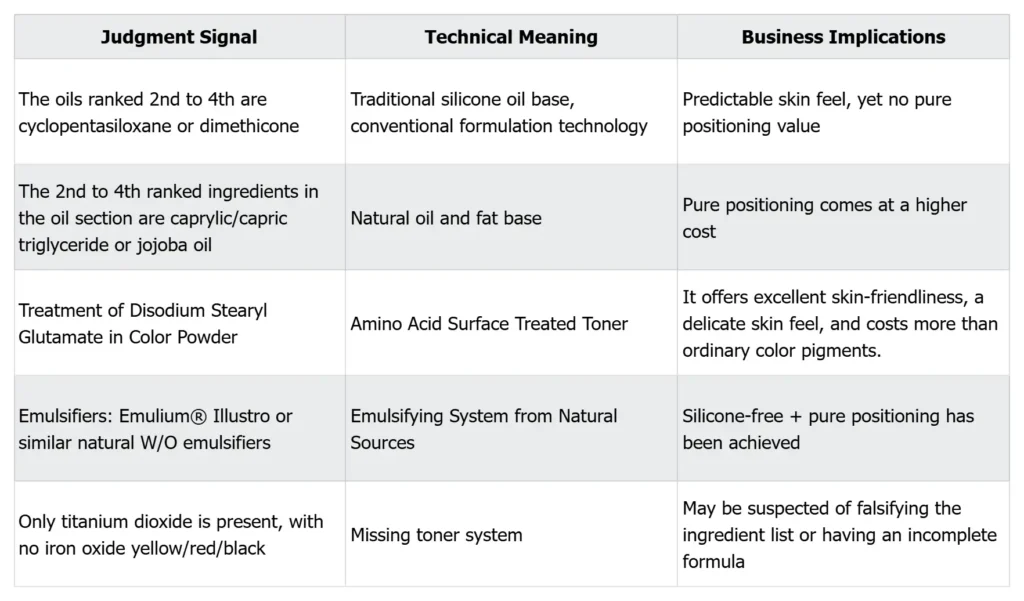
3.2 Underlying Logic of Color Code Development
The development of foundation shades goes far beyond mere color matching, as it involves the synergy between base ingredients and pigment systems.
Formulation Specificities of Deep-Skin Foundation:
- Filler Selection: Traditional fillers (such as talc and mica) tend to leave a greyish-white cast on deep skin tones, while modern fillers like non-nano silica can effectively avoid this issue.
- Scientific nature of pigment ratio: Dark skin tones come in a variety of undertones including olive, neutral, cool and warm. A simple mix of only white + yellow + red + black will result in a grayish-white cast. Successful brands such as NARS, Fenty and Maybelline invest more time and resources in the shade development stage
- Skin-feel consistency across shades: The proportion of base ingredients for different shades must remain consistent. Darker shades, due to the different proportion of color powder, have higher requirements for the load-bearing capacity of the base ingredients.
Data Reference: Geraldine Molina, a cosmetic chemist at Glossier, points out that the base formulation of foundation powder consists of titanium dioxide (white) plus red, yellow and black iron oxides, with occasional blue iron oxide. Since red and yellow are inherently warm-toned, black and white are required to be blended to create cool undertones.
3.3 Differences in Base Ingredient Selection for Products at Different Price Points
Based on industry formula cost data and public patent information:

Core Rule: For every price tier increase, the cost input for base ingredients rises approximately 1.5 to 2 times. —— This is mainly reflected in three dimensions: upgrading of oil types (mineral oil → natural oil → functional oil), upgrading of pigment surface treatment (untreated → silicone oil treatment → amino acid treatment → dual treatment), and upgrading of emulsification technology (traditional O/W → multiple emulsion).
3.4 Checklist for Base Ingredient Inspection of Private Label Product Selection
When a supplier provides a foundation formula, it is recommended to ask the following questions:

Conclusion: The base component serves as the watershed for screening private-label suppliers
The base formulation is the silent determinant of foundation quality: it accounts for 95% of the formula cost, and dictates the skin feel, wear time and stability of the product. Most category analyses only focus on the star active ingredients that make up 0.1-5% of the formula, while neglecting the remaining 95%.
Key Takeaways:
- When selecting foundation products, prioritize asking about the type of oils used, the processing method of color pigments, and the emulsification technology adopted, rather than inquiring about the added active ingredients first.
- Only suppliers who are meticulous about base components can be genuine partners with robust R&D capabilities
- Low-end products rely on adding active ingredients to market gimmicks, while high-end products build a genuine barrier in skin feel by optimizing base formulations.
CTA:
Contact our team to audit your supply chain for true quality.
Return to the main guide on private label foundation sourcing for a complete strategic overview.
Keep Reading:
- Back to Category Decision Manual
- Start with Formulation Basics
- How to Choose Functional Ingredients
- Validate with Proper Testing
Explore More: