
Guide to Foundation Efficacy Testing and Compliance Verification
Table of Contents
- I. Why have clinical trials evolved from a bonus advantage into a mandatory entry threshold?
- 2. Regulatory Classification Framework for Cosmetic Efficacy Claims
- 3. Complete Test Report
- Test Report 1: Long-Lasting Wear Performance Test (24 Hours)
- Test Report 2: Moisturizing Efficacy Test (28 Days)
- Test Report 3: Barrier Repair Test (28 Days)
- Test Report 4: Soothing Efficacy Test
- Test Report 5: Oil Control Efficacy Test (12 Hours)
- Test Report 6: Comedogenicity Test (28 Days)
- Test Report 7: 28-Day Skin Irritation Test
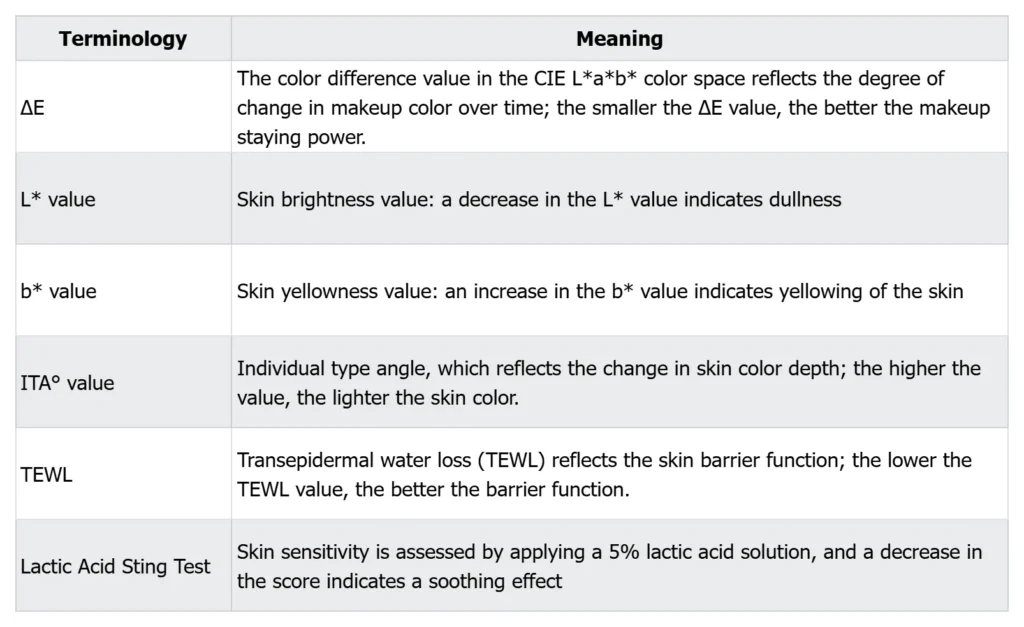
- Glossary of Technical Terms Used in the Report
- 4. Special Test Requirements for Sunscreen Foundation
- 5. Skin Physiological Indicators and Test Background
- 6. Physical and Chemical Tests as a Supplementary Method
- 7. Summary and Conclusion of Test Reports
- 8. Common Certification Labels
- 9. Appendix: Private Label Test Planning Guide
Original version:
In the foundation category, the compliance threshold for efficacy claims is rising rapidly. Clinical test data has evolved from a bonus to a mandatory entry requirement — non-comedogenicity tests, long-wear efficacy tests, etc. have become basic expectations for sophisticated consumers, while the US MoCRA and China’s Evaluation Standards for Cosmetic Efficacy Claims are translating these expectations into regulatory requirements.
This paper systematically sorts out the regulatory classification framework, seven clinical test dimensions, special sunscreen test, interpretation of skin physiological indicators and supplementary physical and chemical test methods involved in the foundation category, and provides complete sample data of test reports, helping private brand sellers incorporate test costs into planning at the formula development stage, so as to prevent products from failing to enter the target market due to insufficient testing.
I. Why have clinical trials evolved from a bonus advantage into a mandatory entry threshold?
1.1 Consumer-side Driving Forces
- 85% of global consumers have at least a moderate level of concern about the ingredients in beauty and personal care products
- 56% of North American consumers prioritize safe, toxin-free cosmetics
- Consumers have been able to distinguish between products that merely add ingredients and those that actually deliver real effects.
- Vice President of Product Development at Saie: Non-comedogenic tests and other certifications have become standard for us, and they are a critical part of building trust
1.2 Regulatory-side Driving Forces

2. Regulatory Classification Framework for Cosmetic Efficacy Claims
For private label sellers, understanding the regulatory tiering of efficacy claims is a prerequisite for controlling compliance costs. Different efficacy claims correspond to different levels of testing requirements, which directly impact product development budgets and time-to-market.
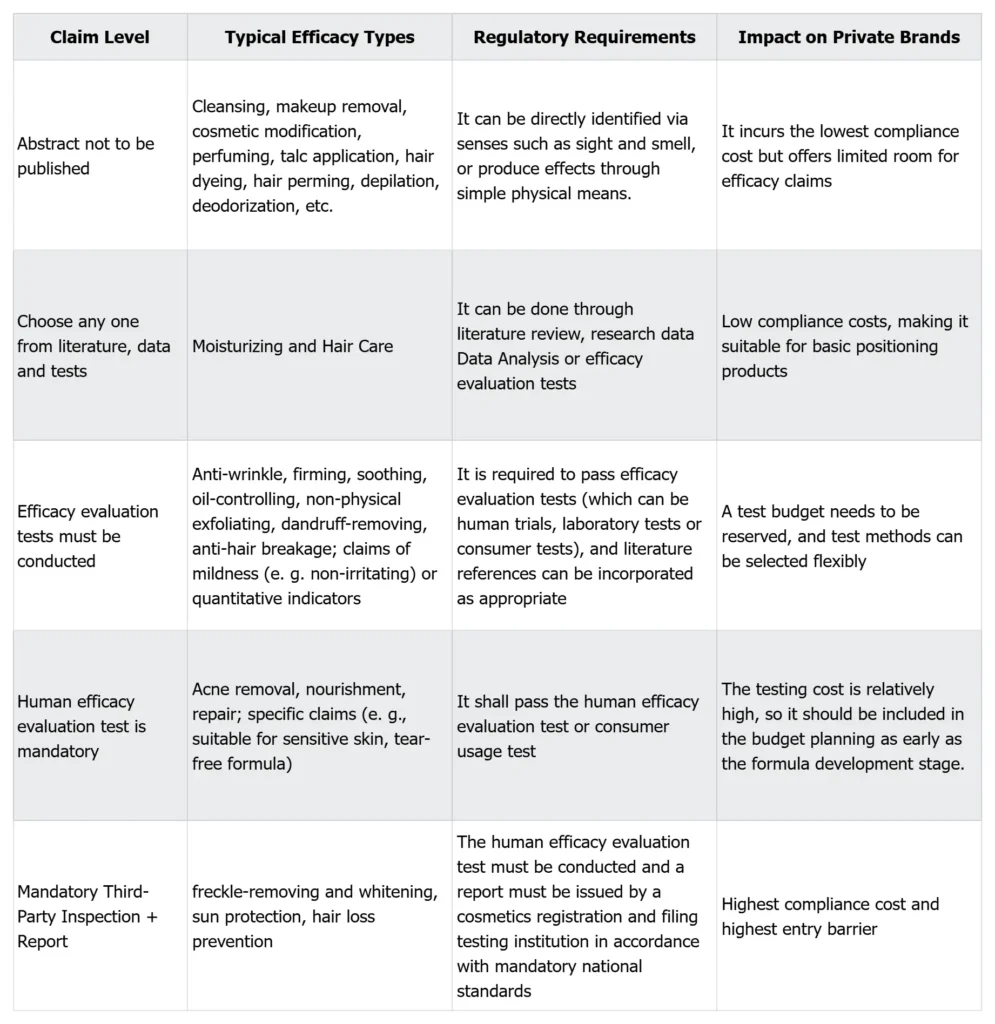
According to the Specification for the Evaluation of Cosmetic Efficacy Claims, the evaluation of cosmetic efficacy claims may be conducted by means of literature materials, research data, or efficacy evaluation tests (including human trials, consumer tests, and laboratory tests), yet there exist clear tiers in the minimum evidence requirements for different efficacy claims.
Direct impact on private brand product selection:
If your foundation is positioned as a basic cosmetic product (with claims limited solely to cosmetic beautification effects), the compliance cost will be extremely low — you will be exempted from publishing the summary of the basis for efficacy claims.
If your foundation is positioned as a skin-caring type (claiming to be moisturizing, repairing, soothing, oil-controlling or suitable for sensitive skin), you need to plan the testing budget in advance:
- Moisturizing claims: Can be supported by literature or in vitro tests, with relatively low compliance costs
- Soothing/oil-control claims: Must be verified through efficacy evaluation tests, which can be selected from laboratory tests or human trials
- Repair claims: must pass human efficacy evaluation test
- Claim for suitability for sensitive skin: Shall be verified through human efficacy evaluation test or consumer usage test
If a sunscreen foundation claims an SPF value: as this constitutes a sunscreen efficacy, it is mandatory for the product to undergo human testing conducted by a filing inspection institution in accordance with mandatory national standards, with an official report issued accordingly — the high cost and long lead time involved form a rigid threshold for entering the sunscreen foundation category.
3. Complete Test Report
Test Report 1: Long-Lasting Wear Performance Test (24 Hours)
Test Basis: Test Method for Long-Lasting Performance of Wet Powder-Based Base Makeup Products
Test Principle: Based on instrumental measurements (skin color difference ΔE, chromaticity ITA° value, lightness L value), the makeup staying effect is evaluated by comparing makeup changes at different time points. The instrumental measurement is based on the CIE L*a*b* color space, where the ΔE calculation reflects color differences; the ITA° value reflects changes in skin tone depth.
Test Method:
- 30 subjects (female, aged 25-45)
- Single-use test foundation applied to the entire face
- Measurements are performed using a skin colorimeter at 0 h, 4 h, 8 h, 12 h and 24 h
- Evaluation metrics: ΔE variation, L value variation, b value variation, ITA° value variation
- Judgment Criteria: A change rate of <5% indicates effective makeup retention
Complete Data Table:
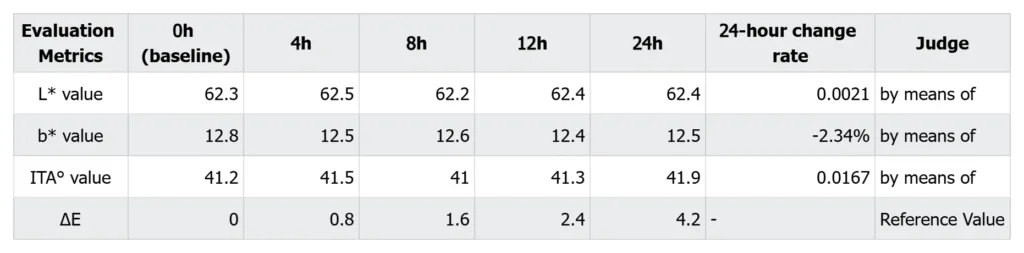
Data Interpretation Standards:
- ΔE < 2: Color difference is barely discernible to the naked eye(excellent makeup staying power)
- ΔE 2-4: Slight visible change (acceptable)
- ΔE > 4: Significant change (touch-up required)
- A change rate of L* value < 5% indicates effective makeup wear.
Test Conclusion: The change rate of L value is 0.21%, the change rate of b value is 2.34%, and the change rate of ITA° value is 1.67%, all of which are below 5% — this proves that the product has a 24-hour long-lasting makeup effect. Simultaneous passing of all three indicators is a mandatory criterion for judging effective makeup retention, and a product will be deemed unqualified if the change rate of any single indicator exceeds 5%.
Test Report 2: Moisturizing Efficacy Test (28 Days)
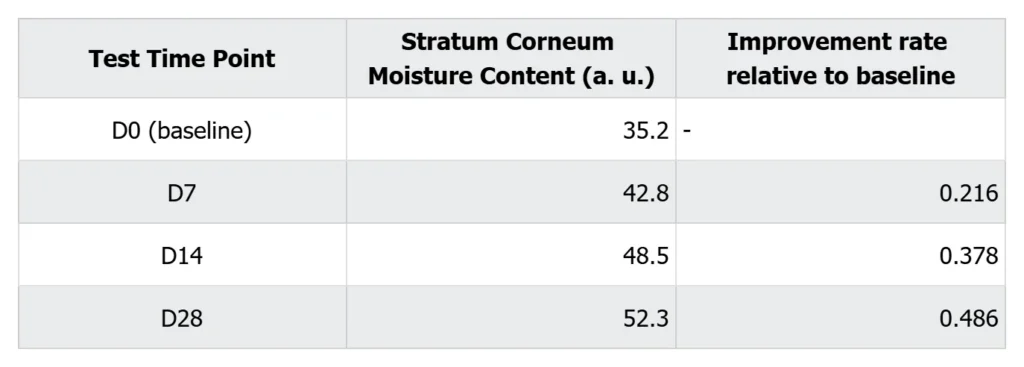
Test Principle: The skin moisture content change before and after using the product is measured via a skin stratum corneum moisture content tester to determine whether the product has moisturizing efficacy.
Test Method:
- 30 subjects with oily and sensitive skin
- Use the test foundation daily for 28 consecutive days
- Measure the stratum corneum moisture content on D0, D7, D14 and D28
Complete Data Table:
Data Interpretation:
- An improvement rate of ≥30% is defined as effective moisturization
- This product has an improvement rate of 48.6%, which is significantly better than the effective standard
Test Conclusion: The product has moisturizing effect.
Test Report 3: Barrier Repair Test (28 Days)
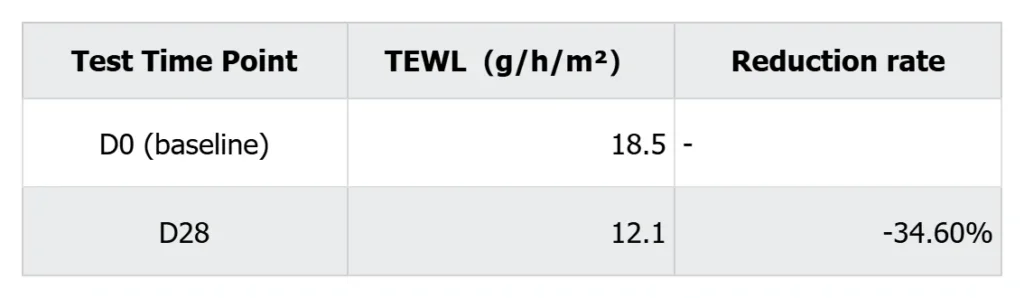
Test Principle: The change of skin barrier function is measured by transepidermal water loss (TEWL) value, and a decrease in TEWL value indicates the improvement of barrier function.
Test Method:
- 30 subjects with oily and sensitive skin
- Measure the TEWL value before using the product (D0) and after 28 days of use (D28)
Complete Data Table:
Data Interpretation:
- A reduction rate of ≥25% indicates effective barrier repair
- The reduction rate of this product reaches 34.6%, which is significantly better than the effective standard
Test Conclusion: The product has barrier repair efficacy.
Test Report 4: Soothing Efficacy Test
Test Basis: Technical Specification for Evaluation of Cosmetic Soothing Efficacy
Test Principle: Lactic Acid Stinging Test – Apply a 5% lactic acid solution to the subject’s face, and evaluate the soothing efficacy of the product by comparing the changes in stinging sensation scores before and after using the product.
Test Method:
- 30 subjects with oily and sensitive skin
- A lactic acid stinging test was conducted before product use (D0) and after 28 days of use (D28)
Complete Data Table:

Data Interpretation:
- A reduction rate of ≥50% is defined as effective relief
- The reduction rate of this product reaches 68.1%, which is significantly better than the effective standard
Test Conclusion: The product has soothing effects.
Test Report 5: Oil Control Efficacy Test (12 Hours)
Test Principle: The sebum control efficacy of the product is evaluated by measuring the difference in sebum content change between the application area and the blank control area using a skin sebum tester.
Test Method:
- 30 subjects with oily and sensitive skin
- The test group uses the product, while the control group does not.
- Measure the sebum content at 0 h, 4 h, 8 h and 12 h
Complete Data Table:

Data Interpretation:
- sebum level in the blank area increases linearly over time, while the increase in the application area is significantly slowed down
- The larger the difference value, the stronger the oil control effect
- The continuous increase in the difference value of this product within 4-12 hours proves that it has a long-lasting oil control effect.
Test Conclusion: The product has oil-controlling efficacy.
Test Report 6: Comedogenicity Test (28 Days)
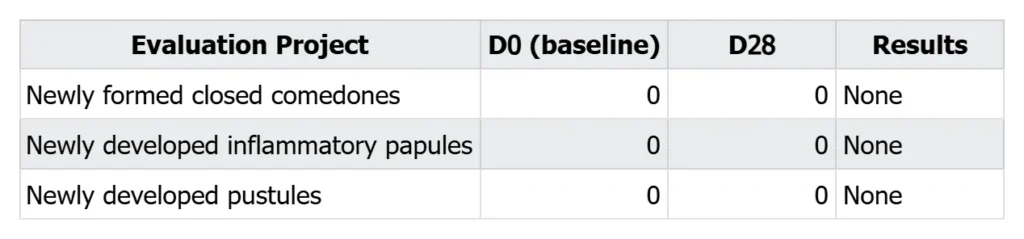
Test Principle: A dermatologist will assess whether new acne (including blackheads, inflammatory papules, and pustules) has developed on the subject’s face after the subject has used the product for 28 days.
Test Method:
- 30 subjects with oily and sensitive skin
- Use the test foundation daily for 28 consecutive days
- Dermatologists performed comedone count assessments at D0 and D28
Complete Data Table:
Data Interpretation:
- No new acne lesions indicate a negative result (i. e., no comedogenic risk)
- The appearance of new acne lesions is considered a positive result, indicating that the product may have comedogenic potential.
Test Conclusion: No comedogenic adverse reactions were observed in 30 subjects after 28 days of use, which verifies that the product poses no comedogenic risk.
Test Report 7: 28-Day Skin Irritation Test
Test Principle: Dermatologists observe and record adverse reactions (such as erythema, edema, pruritus, and desquamation) during the 28-day period when subjects use the product.
Test Method:
- 30 subjects with oily and sensitive skin
- Use the test foundation daily for 28 consecutive days
- Dermatologists will assess the skin condition on D0, D7, D14 and D28
Complete Data Table:

Test Conclusion: All 30 subjects showed no adverse reactions after 28 days of use, which proves that the product is mild and non-irritating.
Glossary of Technical Terms Used in the Report
4. Special Test Requirements for Sunscreen Foundation
Foundations with sun protection efficacy must meet the special test requirements for sunscreen products, with the core indicators being SPF value, water resistance and PA value (UVA protection grade).
(I) SPF Value Determination (Sunburn Protection / UVB Protection)
SPF (Sun Protection Factor) is an internationally recognized indicator for evaluating a product’s ability to protect against UVB, which is determined via an in vivo human test. The test principle is as follows: before and after applying a specified dose (2 mg/cm²) of sunscreen product, the subject’s back is irradiated with incrementally increasing doses of an ultraviolet light source simulating the solar spectrum, and the minimal erythema dose (MED) of both unprotected and protected skin is measured respectively; the SPF value is the ratio of the two MED values.

SPF Value and Corresponding Protection Level: Common labeled values include SPF 15,30,50, and 50+. The cost of SPF value testing typically ranges from $2,000 to $5,000 per product, and the testing must be conducted by a qualified inspection body.
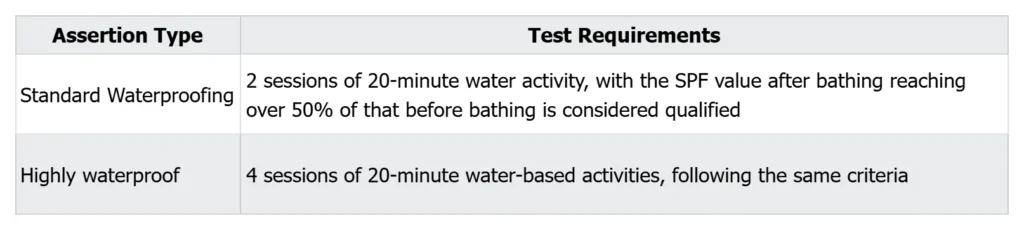
(2) Waterproof Performance Test
If a foundation claims to be waterproof or highly waterproof, it shall pass the waterproof performance test:
3) PA Value Determination (Sunburn Prevention / UVA Protection)
The PA value (Protection Grade of UVA) is used to evaluate a product’s protection against UVA. By measuring the Minimal Persistent Pigment Darkening (MPPD), the UVA Protection Factor is calculated, which corresponds to the PA+, PA++, PA+++, and PA++++ rating levels.
Compliance Self-Checklist for Sunscreen Foundation:

5. Skin Physiological Indicators and Test Background
Understanding the skin physiology principles underlying the tests enables private label sellers to make accurate judgments when interpreting test reports, as they will know what changes in the indicators signify, rather than just looking at the numbers.
(I) Transepidermal Water Loss Attrition Rate (TEWL)
TEWL is a core direct indicator for evaluating skin barrier function, referring to the amount of water vapor that diffuses through the epidermis into the external environment per unit time.
- Principle: The measurement is based on Fick’s law of diffusion, and the calculation is performed by measuring the water vapor pressure gradient near the skin surface. When the skin barrier is damaged, the TEWL value increases.
- Significance in foundation testing: In the testing of barrier-repair foundations (e. g., those formulated for sensitive skin), the TEWL reduction rate serves as the key evidence for determining efficacy. For a product to be effective, its TEWL reduction rate should be ≥25%.
- Measurement method: Use an open or semi-open cavity probe with a built-in high-precision temperature and humidity sensor, and perform measurement under strictly controlled ambient temperature and humidity conditions.
(2) Stratum Corneum Moisture Content
The water content of the stratum corneum reflects the basic hydration status of the skin and serves as an indirect indicator of intact barrier function.
- Principle: The dielectric constant of water is much higher than that of other skin components, so the moisture content can be indirectly calculated by measuring the capacitance value.
- Significance in foundation testing: A core indicator of moisturizing efficacy. An effective moisturizing foundation should achieve a water content increase rate of over 30%.
- Measurement methods: The capacitive method is the most commonly used one, and there are also the conductance method and the susceptance method.
(3) Skin pH Value
The pH value of the skin surface reflects the stability of the skin microenvironment. Healthy skin is weakly acidic (pH 4.5-5.5), and abnormal pH values are associated with a variety of skin problems.
(4) Tape Peel Test
Mild barrier damage was simulated by continuously stripping stratum corneum cells, and the recovery capacity of barrier function was dynamically monitored.
Correspondence between test indicators and commercial claims:

6. Physical and Chemical Tests as a Supplementary Method
Physical and chemical testing is a key component of the efficacy evaluation system. According to the Specification for the Evaluation of Cosmetic Efficacy Claims, cosmetic efficacy claim evaluation tests fall into three categories: human efficacy evaluation tests, consumer use tests, and laboratory tests.
Advantages of physical and chemical tests:
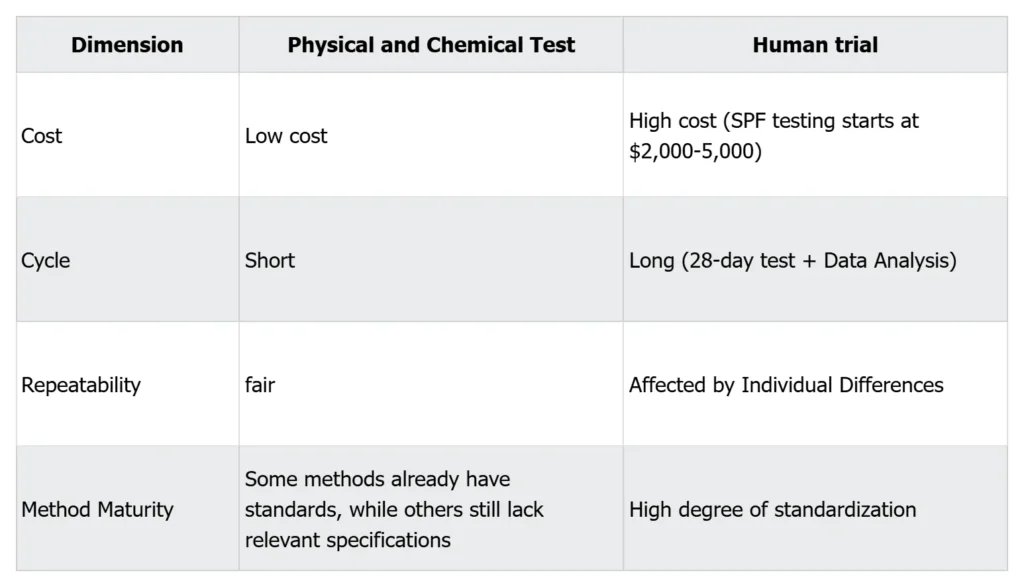
Existing limitations: Some efficacy claims lack appropriate physical and chemical testing methods, the same test indicator may correspond to multiple efficacy claims, and certain standards are not applicable to specific product types.
Main types of physical and chemical tests:
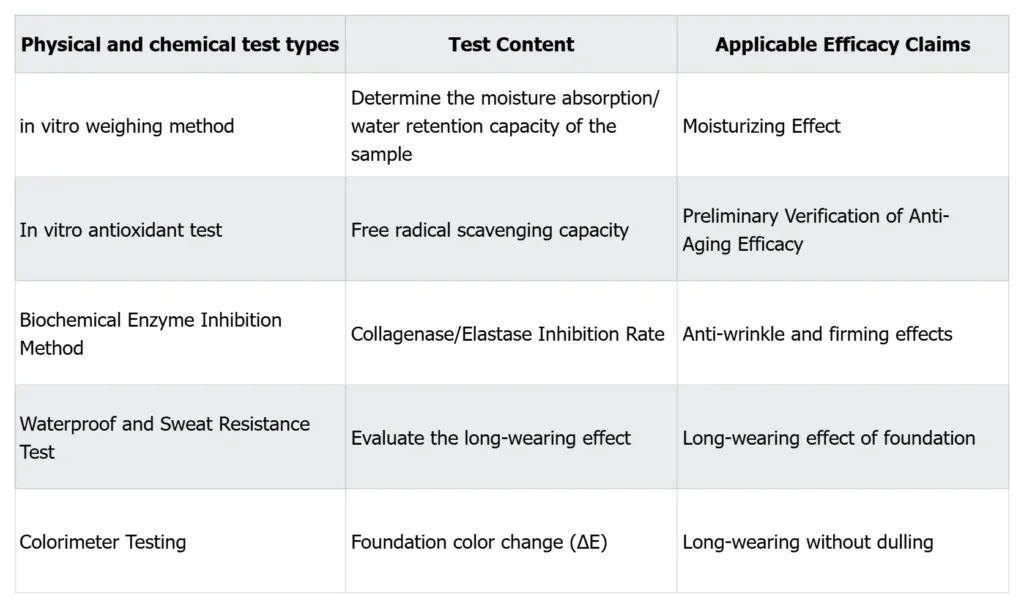
Application Strategy for Private Brands:
- Formulation Development Phase: Rapid screening is conducted via physical and chemical tests to validate formulation directions
- Regulatory Compliance Phase: For efficacy claims such as moisturization, physical and chemical tests can serve as formal evidence
- Evidence closed loop: Physical and chemical tests serve as in vitro evidence, while human trials serve as in vivo evidence, and the two form a complementary system
7. Summary and Conclusion of Test Reports
Based on the complete data from the above seven tests, the conclusion on the comprehensive efficacy of the tested foundation is as follows:

8. Common Certification Labels

9. Appendix: Private Label Test Planning Guide

CTA:
Contact our team to guide you through the testing process.
Return to the main guide on private label foundation sourcing for a complete strategic overview.
Keep Reading:
- Back to Category Decision Manual
- Master Formulation Science
- Select the Right Actives
- Don’t Overlook Base Ingredients
Explore More: