
Compliance as a Competitive Advantage: Quality & Safety in Private Label
Table of Contents
How robust quality control and regulatory compliance build consumer trust, support premium claims, and protect your brand’s reputation in OEM and ODM partnerships.
Introduction
In premium beauty, quality and compliance are not just operational requirements—they are competitive advantages. Consumers who pay premium prices expect premium quality. A single quality failure can undo years of brand building and damage consumer trust.
For private label brands, navigating the regulatory landscape can be complex. But those who invest in robust quality control and compliance systems gain a significant edge—building trust with consumers, retailers, and regulators alike.
This guide explores how private label brands can turn compliance into a competitive advantage and why partnering with the right OEM or ODM manufacturer is essential.
This guide is part of our comprehensive series on private label premiumization. For a complete overview of the strategy, read the main guide here →
Compliance requirements vary by formulation type. Start with our semi-custom playbook →
The Business Case for Quality
Quality control is not just a regulatory requirement—it’s a competitive advantage. Premium brands command premium prices because consumers trust their quality.
The cost of quality failure:
- Recalls: Product recalls are expensive and damaging to brand reputation
- Regulatory action: Fines, warning letters, and market bans can derail a brand
- Consumer trust: Loss of consumer confidence can take years to rebuild
- Retailer relationships: Retailers may delist brands with quality issues
The upside of quality investment:
- Price premium: Consumers pay more for trusted quality
- Consumer loyalty: Quality builds repeat purchases and word-of-mouth
- Retailer confidence: Strong quality systems make brands easier to sell to retailers
- Brand reputation: Quality becomes part of the brand’s narrative
Key Compliance Considerations for Private Label Brands
Regulatory Accountability
As the brand owner placing the product on the market under its own name, you are typically the legally accountable party. This is true even when using a contract OEM or ODM manufacturing organization for part or all of production.
Key responsibilities:
- Appointing a “Responsible Person” accountable for safety and labeling
- Ensuring each product has its own Cosmetic Product Safety Report (CPSR)
- Maintaining technical documentation with full traceability to the actual SKU
- Not recycling documentation from other brands or formulations
Testing and Validation
Finished product testing must be conducted under the brand name, not just on theoretical formulations.
Required testing:
- Safety assessments: Evaluation of ingredient safety and product toxicity
- Microbial stability: Testing for preservative efficacy and microbial contamination
- Stability testing: Confirming the formula remains stable under various conditions
- Challenge testing: Evaluating the product’s resistance to microbial growth
Documentation and Traceability
Each product should have its own documented:
- Batch production records
- Testing results (microbial, stability, challenge)
- Safety assessments (CPSR)
- Ingredient percentages
- Raw material safety data sheets (SDS)
The Fir Beauty Quality Standard
Every product that carries the Fir Beauty promise passes through strict quality control in ISO 22716 (Cosmetics GMP) certified facilities. This commitment to quality is not an afterthought—it is the foundation of our high reputation among repeat buyers worldwide and a key enabler of private label brands’ premiumization journey.
Our multi-layered quality system includes:
- In-process checks throughout production to catch issues early
- Pre-shipment inspections available at the brand’s request—free of charge
- Third-party testing by accredited international labs covering:
- Heavy metals (lead, mercury, arsenic, cadmium)
- Microbial limits (total plate count, yeast & mold, pathogens)
- Stability (accelerated and real-time testing)
- Color accuracy (spectrophotometric verification)
Before any bulk shipment leaves our dock, we only dispatch when everything matches the approved sample. Brands can request a free pre-shipment inspection against their approved sample or specification sheet at any time.
This multi-layered system ensures that every product that bears your brand name meets the quality standards your premium consumers expect. Whether you’re working with us on an OEM project or a full ODM development, quality is non-negotiable—and we have the certifications, testing protocols, and traceability systems to back it up.
See real-world examples of quality standards in Case Studies →
Leveraging Compliance as a Premium Signal
Many low-cost providers offer “template” safety assessments with insufficient testing and unverifiable supplier documents. These may allow for regulatory submission but fail under authority audits, exposing brands to recall orders, fines, and reputational damage.
Premium brands invest in robust compliance:
- Full ingredient percentages with traceability
- Raw material safety data sheets (SDS)
- Microbial and stability testing
- Batch production specifications
- Safety assessments authored by certified professionals
This investment not only protects against regulatory risk but also signals quality to consumers, retailers, and distributors. In the premium market, compliance is not a cost—it’s a competitive advantage that justifies your price point and builds lasting trust.
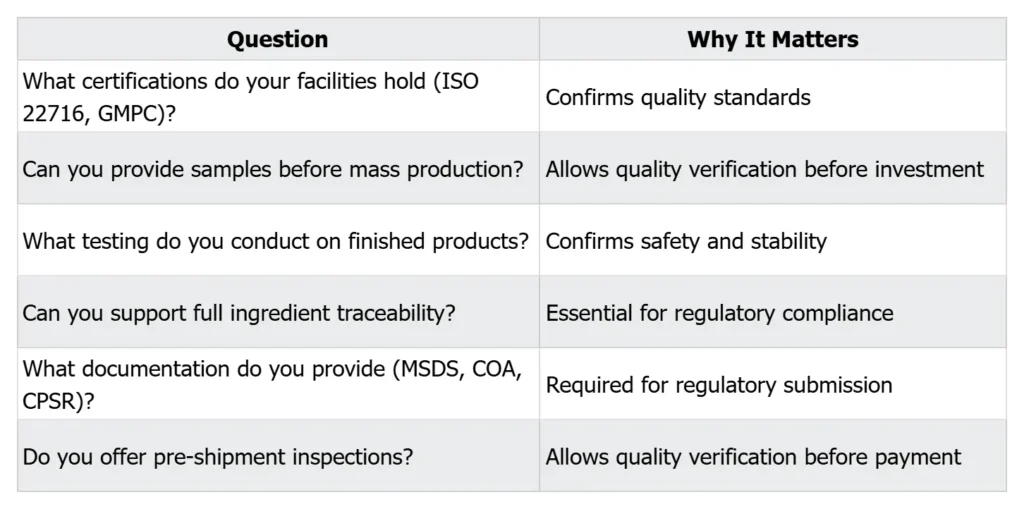
Questions to Ask Your OEM/ODM Manufacturing Partner
Conclusion
Quality control and regulatory compliance are not just operational requirements—they are competitive advantages that support premium positioning. By investing in robust testing, documentation, and accountability, private label brands build consumer trust, protect their reputation, and justify premium pricing.
Fir Beauty provides the quality infrastructure private label brands need to succeed in regulated markets—certified facilities, documented testing, and full regulatory support—so brands can focus on building their story while we ensure the quality. Whether you’re exploring your first OEM partnership or scaling an existing ODM program, compliance is the foundation upon which premium brands are built.
Learn how packaging choices affect compliance →
Contact our team → to discuss your compliance needs.
Return to the main guide on private label premiumization → for a complete strategic overview