
Foundation Category Decision Manual: A Complete Framework from Market Landscape to Supply Chain Screening
Table of Contents
- Abstract
- 1. Market Size and Growth Structure
- 2. Category Forms and Functional Evolution
- 2.1 Core Judgment
- 2.2 Complete Comparative Analysis of Product Form
- 2.3 Analysis of Hiding Power Levels
- 2.4 Systematization of Makeup Effect Spectrum
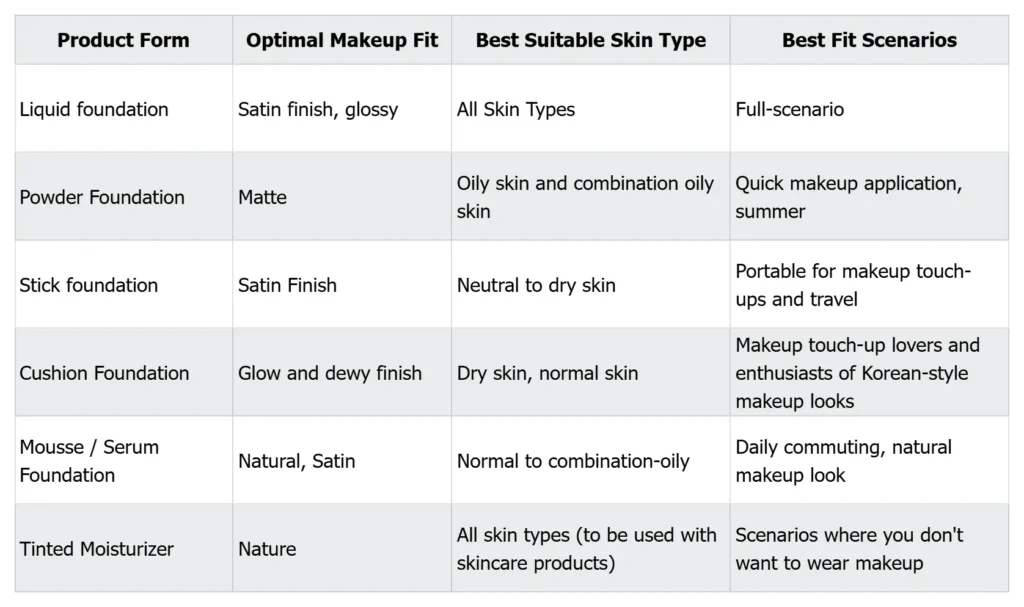
- 2.5 Matching Matrix of Product Form, Makeup Effect and Skin Type
- 2.6 Three Core Makeup Effect Trends
- 2.7 Other Notable Trends
- 2.8 Category Substitution Relationship Analysis
- 3. Price Range and Consumer Groups
- 3.1 Price Tier Pyramid of the Foundation Category
- 3.2 The Particularity of the Pricing Mechanism: The High Trial-and-Error Cost of Foundation
- Definition of trial-and-error cost: What is trial-and-error cost?
- Monetary Cost: Unit Price of Foundation vs. Unit Price of Lip Products
- Time cost: The time cost of a trial and error is 30 to 90 times that of lip products.
- Emotional Cost: Foundation forms the base of a makeup look
- Opportunity cost: a wrong foundation pick means wasting the entire chunk of time you spent on makeup.
- Impacts on Consumers’ Purchasing Behavior
- 4. Overview of Ingredients and Technology
- 5. Clinical Trial and Efficacy Verification System
- 6. Channel Landscape and Brand Competition
- 6.1 The Channel Landscape Is Being Redefined
- 6.2 TikTok Shop: The Fastest-Growing Channel for Foundation Category
- 6.3 Amazon: The Search Battlefield of the Foundation Category
- 6.4 Sephora: The Certification of Brand Value
- 6.5 Correspondence Logic of Channel-Product-Technology
- 6.6 Brand Competition Landscape: The Giants’ Turf and the Cracks of Private Brands
- 7. Specification Strategy and Supply Chain Decisions
- Collaborative Relationship Between Channels and Supply Chains
- The High Barriers and Niche Entry Points of the Foundation Category
Original version:
Abstract
Foundation is the product category in the cosmetics sector that boasts the largest market size, the highest entry barriers and the strongest consumer loyalty.
Key Findings
- The US foundation market will reach USD 2.43 billion in 2025, and is projected to grow to USD 4.29 billion by 2034, registering a CAGR of 6.51%. This growth is driven by rising unit prices and multifunctional product offerings, rather than an expansion in sales volume.
- Foundation is evolving from a purely cosmetic product to a skin-enhancing one. 26% of color cosmetics consumers rank skin-caring properties as the second most important consideration, right after makeup effect, and 91% pay attention to the active ingredients in base makeup products.
- The base formulation is the true competitive edge of foundation — it accounts for 70-95% of the formula and dictates over 90% of the application experience. The vast majority of category analyses only fixate on the 0.1-5% star active ingredients.
- Clinical trial data is shifting from being a bonus to a threshold for market access. The Evaluation Standards for Cosmetic Efficacy Claims require that all efficacy claims must be backed by scientific evidence, and the US MoCRA has also tightened Regulatory Scrutiny over efficacy claims.
- The optimal entry path for private labels: lower the trust threshold with mini sizes or 3-5 core shades → establish differentiation via skincare-focused ingredients and cleansing positioning → forge in-depth partnerships with supply chains equipped with clinical testing capabilities.
1. Market Size and Growth Structure
1.1 Overall Market Size
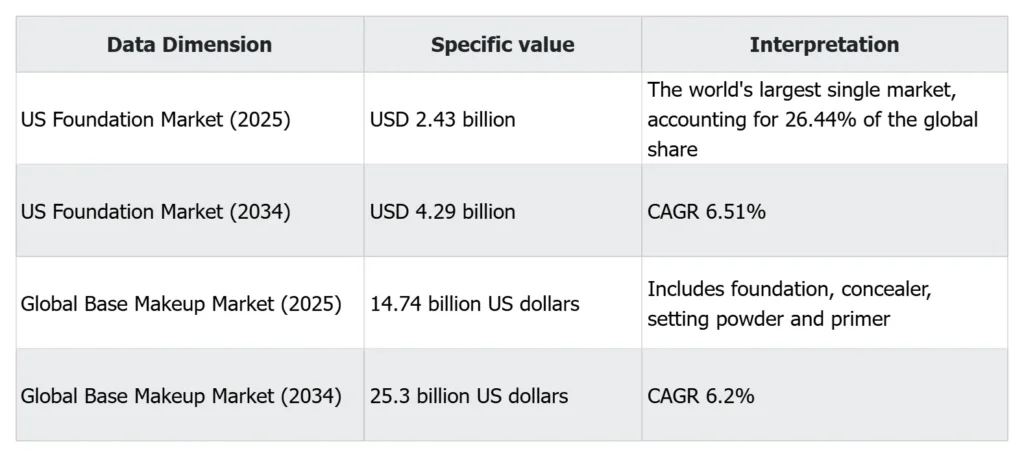
The growth of the foundation category is driven by rising unit prices and functional integration — consumers no longer purchase just one bottle of foundation, but instead build a “base makeup wardrobe”: a daily tinted moisturizer, a high-coverage foundation for important occasions, and a sunscreen BB cream for weekends.
The product line featuring core ingredients including nicotinamide, hyaluronic acid and peptides registered a year-on-year growth in the triple digits.
1.2 Category Form Structure

1.3 Makeup Effect Requirement Structure
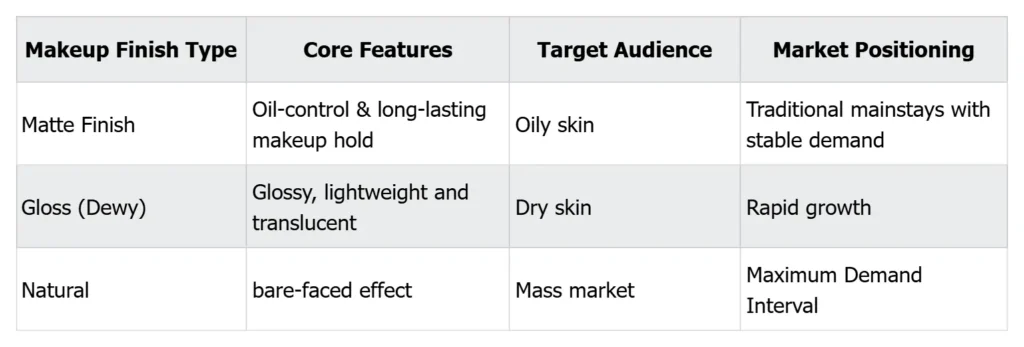
Consumer Data: 70% prefer natural nude makeup, 43% favor a matte finish, and 38% go for a dewy skin look.
2. Category Forms and Functional Evolution
2.1 Core Judgment
The core evolution of the foundation category is that it has transformed from coverage-oriented products to skin-enhancing products.
Consumers no longer value complexion products purely for their coverage. They expect them to contribute to skin health as well.——Ilia Sasha Plavsic
2.2 Complete Comparative Analysis of Product Form
The product forms of the foundation category go far beyond the binary division of liquid vs. powder. Different forms correspond to different consumption scenarios, makeup application habits and customer group preferences:
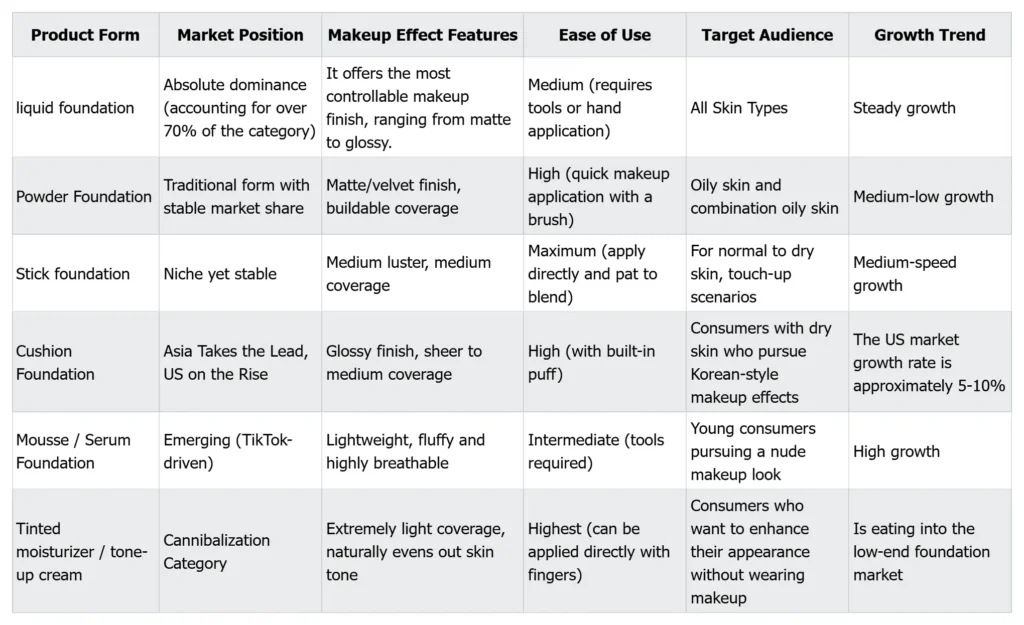
Tarte BB Blur registered a year-on-year growth of 368%, while The Ordinary Serum Foundation saw a 212% year-on-year increase. Both products share the common features of being lightweight and skincare-infused, indicating that consumers are shifting from traditional foundation to more lightweight base makeup formats.
This trend means one thing for private label brands: the territory of the foundation category is being eroded by adjacent categories, and brands need to make a choice between extreme professionalism and extreme convenience — they cannot serve both types of consumers at the same time.
2.3 Analysis of Hiding Power Levels
The distribution of coverage power in the foundation category is a key dimension for understanding consumer profiles:

Buildable coverage is becoming the standard for a new generation of foundations — as it allows consumers to adjust the concealing power according to their own needs, and also means the same product can cater to more skin types and scenarios, delivering a notable boost to SKU efficiency.
2.4 Systematization of Makeup Effect Spectrum
The current report only lists three makeup finishes: matte, dewy, and natural, yet a more granular continuous spectrum of makeup finishes actually exists in the market:
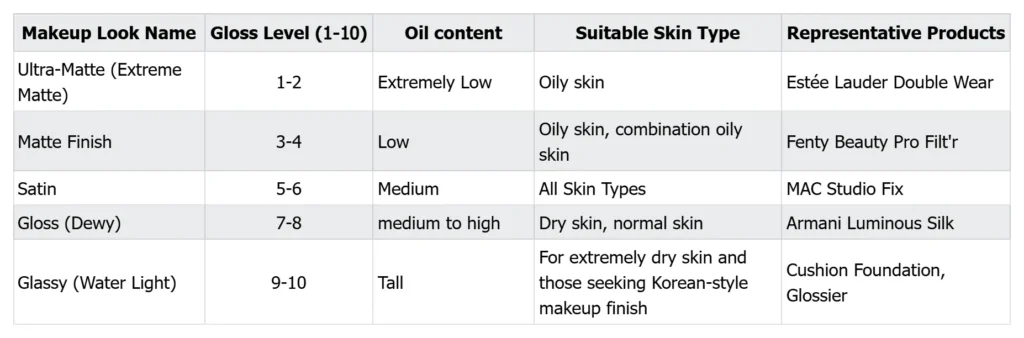
Satin finish is the most popular makeup effect, catering to the broadest consumer group across all skin types. If a private label only launches one version of makeup finish, satin is the safest bet; if it launches two versions, the classic combination is matte + dewy finish.
2.5 Matching Matrix of Product Form, Makeup Effect and Skin Type
2.6 Three Core Makeup Effect Trends

2.7 Other Notable Trends
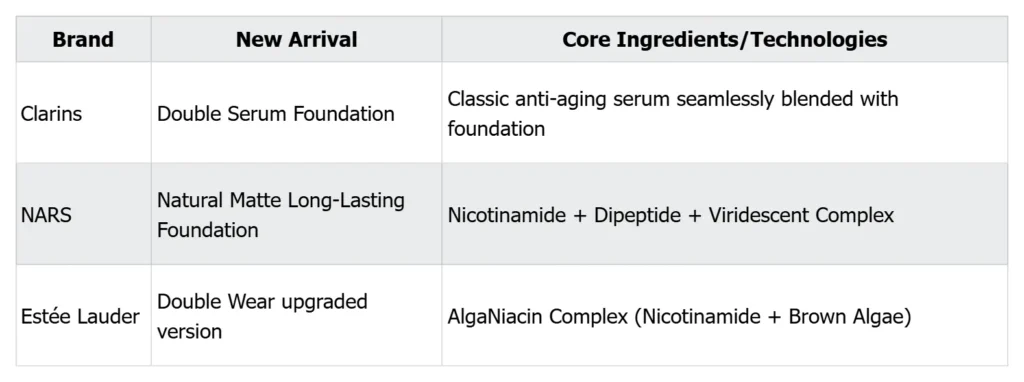
Trend 4: Integration of Makeup and Skincare — A Structural Trend
26% of cosmetics consumers regard skin-caring effect as the second consideration, and 91% of them pay attention to the active ingredients in base makeup products.
Trend 5: Authenticity Replaces Perfection (Aesthetic Trend)
The biggest makeup trend for base makeup in 2026 is the natural dewy skin look. It doesn’t need to be perfectly flawless; instead, it should deliver the radiance that makes your skin look inherently great. — Enzo Fournier, Global Makeup and Training Director at Clarins
Trend 6: The Rise of the “Makeup Wardrobe” Concept (Consumer Behavior Trend)
Data support: Tarte BB Blur saw a year-on-year increase of 368%, and The Ordinary Serum Foundation registered a 212% year-on-year growth.
2.8 Category Substitution Relationship Analysis
The biggest structural threat facing the foundation category comes from the encroachment of adjacent categories, particularly tinted moisturizers and BB/CC creams:
The Logic of Salami Tactics:
- Skincare-oriented trend: Tinted moisturizers inherently carry a skincare positioning, which aligns with the trend of integrating makeup and skincare benefits
- Low decision-making cost: The light coverage positioning of tinted moisturizer means it is hard to go wrong, with a lower trial-and-error risk
- Low decision-making cost: The light coverage positioning of tinted moisturizer means it is hard to go wrong, with a lower trial-and-error risk
Data Support:
- Search Data: The search volume growth rate of tinted moisturizer outpaces that of foundation
- New brands tend to launch tinted moisturizers rather than foundations, as the foundation category is already dominated by industry giants.
- New brands tend to launch tinted moisturizers rather than foundations, as the foundation category is already dominated by industry giants.
Impact on private brands:
- Tinted moisturizer can serve as a traffic entry for the foundation category, attracting consumers who are hesitant to try foundation products.
3. Price Range and Consumer Groups
3.1 Price Tier Pyramid of the Foundation Category

Core Contradiction: A 10% price hike would trigger a 59% churn rate, while reliance on promotions remains equally high — 50% of respondents are highly or fairly dependent on discount activities.
3.2 The Particularity of the Pricing Mechanism: The High Trial-and-Error Cost of Foundation
In the analysis of the pricing mechanism for the foundation category, we mentioned that the core feature that distinguishes foundation from lip products is its high trial-and-error cost. However, it should be made clear that the high trial-and-error cost of foundation is not a problem with the product itself, but rather the result of the interaction between category characteristics and consumer decision-making logic.
Definition of trial-and-error cost: What is trial-and-error cost?
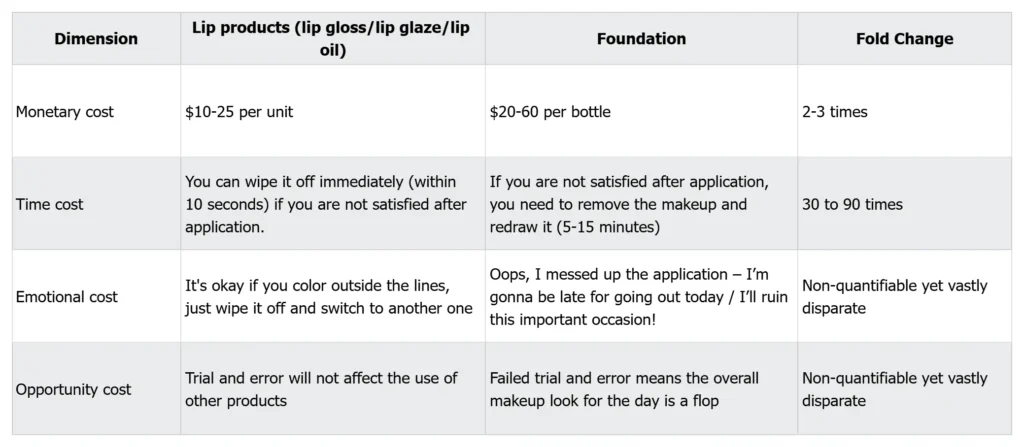
Trial-and-error cost refers to the comprehensive price that consumers pay in four dimensions — time, money, emotion and opportunity — when they try a new product and find it unsuitable.
Monetary Cost: Unit Price of Foundation vs. Unit Price of Lip Products
The unit price of lip products (lip gloss/lip oil/lip glaze) typically ranges from $10 to $25. For foundation, the mid-range price band is $20-30, the budget segment is $10-15, and the premium tier is $30-60. Judging solely from monetary cost, even though foundation carries a higher unit price, it still falls within the acceptable range for consumer goods. The discrepancy in monetary cost is insufficient to account for the full implication of high trial-and-error costs.
The key difference is this: for lip products, you can buy 5 different shades at a cost of $10-15 each, totaling $50-75, and as a result, the consumer has 5 options to choose from. For foundation, you might purchase 3 different shades at $25-30 each, for a total outlay of $75-90, yet the consumer will only end up using one of them, leaving the other two completely wasted. Trial and error with lip products is cumulative — it adds to the range of shades you have available — whereas trial and error with foundation is a sunk cost: the unused shades are simply thrown away.
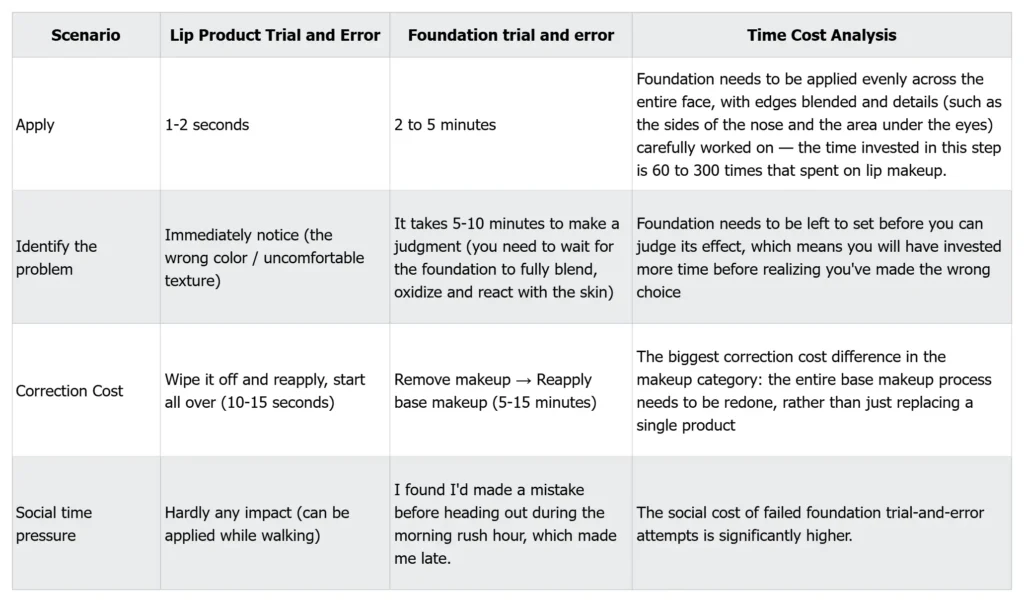
Time cost: The time cost of a trial and error is 30 to 90 times that of lip products.
This is one of the core dimensions of the high trial-and-error cost of foundation: spending 10 seconds testing and potentially making a mistake on a lip product, versus spending 5 to 15 minutes doing so on a foundation, has a completely different level of disruption to consumers’ daily lives.
Emotional Cost: Foundation forms the base of a makeup look
The trial-and-error for lip products is limited to a small localized area, whereas a failed trial-and-error with foundation means the entire makeup look is ruined.

Opportunity cost: a wrong foundation pick means wasting the entire chunk of time you spent on makeup.
When a consumer has spent 5 to 15 minutes doing their makeup only to find that the foundation doesn’t suit them, the options they face are:
Option A: Go out with an unsatisfactory makeup look (which will ruin your mood and appearance for the whole day)
Option B: Remove makeup and redraw (re-invest 5-15 minutes, and may face the risk of being late)
When it comes to lip products, picking the wrong shade is just a localized issue that can be fixed by wiping it off and reapplying. But with foundation, choosing the wrong one spells total failure, forcing you to start all over from scratch.
Decision Chain Domino Effect:
Wrong shade selection → the entire makeup looks off → cannot be fixed with eye makeup or blush → the only option is to redo the entire face → redoing the makeup eats up time that could have been spent on other tasks → the day’s schedule gets disrupted → develops a psychological fear of blindly testing new foundations (a fear that never arises from trial and error with lip products)
Impacts on Consumers’ Purchasing Behavior
Due to the combined effect of the above four dimensions (monetary waste, time cost, emotional impact and opportunity loss), fundamental changes have taken place in consumers’ purchasing behavior:

4. Overview of Ingredients and Technology
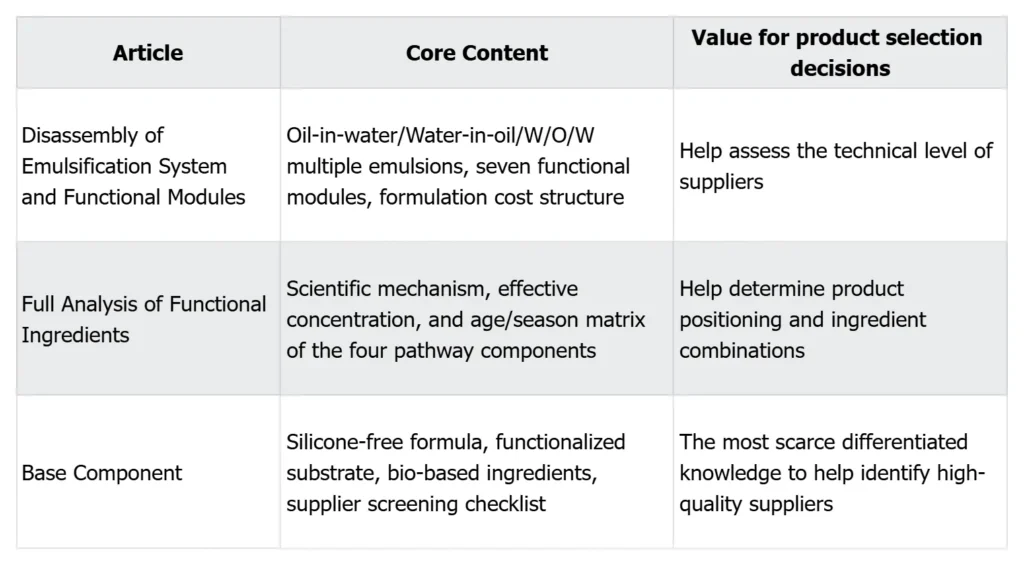
The formulation of liquid foundation scientifically integrates colloid chemistry, dermatological science, and bioactive ingredients. Below is a summary of the core findings; please refer to the three in-depth subpages for detailed information.
4.1 Overview of the Core Framework
4.2 Four Core Conclusions
Conclusion 1: The emulsification system determines the dividing line of skin feel
Foundation is essentially a type of emulsion, which falls into two basic categories based on its continuous phase:

The ability to stably produce multiple emulsion systems is a key indicator that distinguishes the technical level of contract manufacturers.
Conclusion 2: The base component accounts for the silent 90%
The base components account for 70-95% of the formula and determine over 90% of the application experience. Most category analyses only focus on the 0.1-5% star active ingredients while ignoring the silent 90%.
Direct takeaway for product selection: When picking foundation products, first clarify what oils are used, how the color pigments are processed, and what emulsification technology is adopted, then ask about the added active ingredients. Base ingredients are the entry ticket, while active ingredients are just bonus points. Without the entry ticket, those bonus points mean nothing at all.
For details, please refer to Foundation Base Ingredients: The Silent 90%
Conclusion 3: Functional ingredients have clear boundaries for their effective concentration
Functional ingredients only account for 0.1-5% in the formula, and their efficacy can only be achieved when reaching a specific concentration:

If a supplier is unable to provide the concentration of the active ingredient added, it indicates that their formula development is still at the level of copying rather than designing.
For details, please refer to A Comprehensive Analysis of Functional Ingredients in Foundation.
Conclusion 4: Regulatory differences between Europe and the United States are a hard constraint for overseas expansion
There are three major compliance differences between products targeting the US market and those targeting the European market:
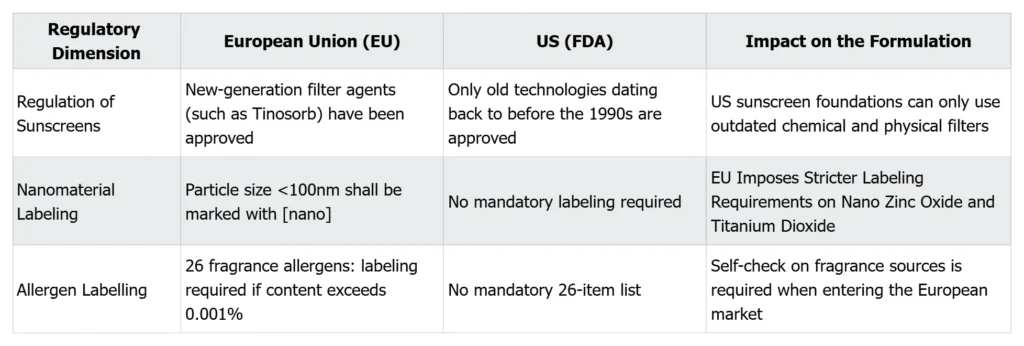
Before a private label enters the European market, it is mandatory to check whether the content of the 26 allergens in the formula exceeds the specified limit.
Efficacy Testing & Compliance Verification – Navigate clinical testing requirements, regulatory frameworks, and certification pathways to ensure your claims are market-ready.
5. Clinical Trial and Efficacy Verification System
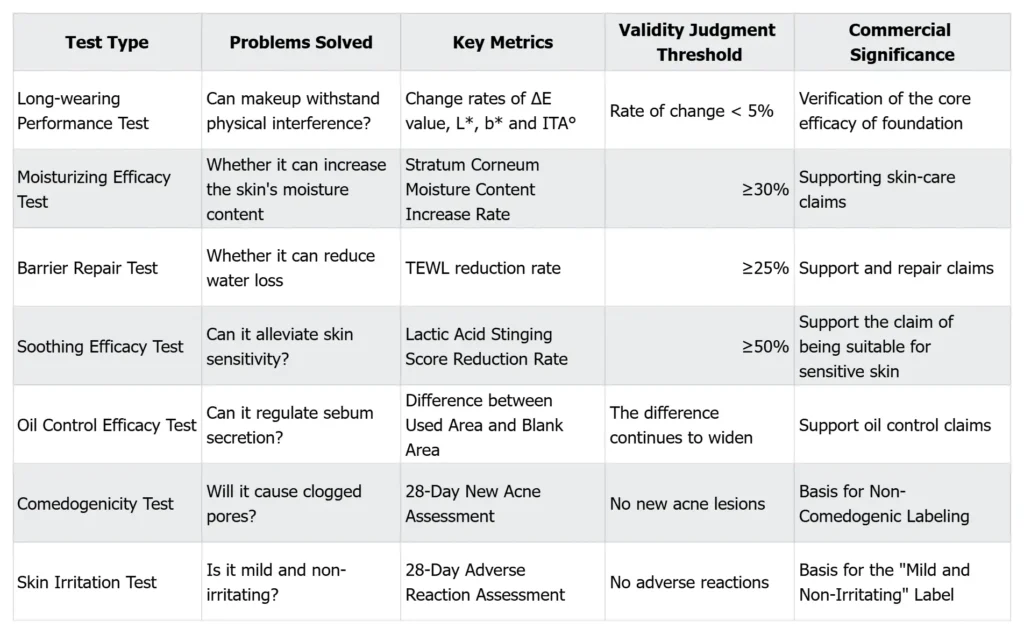
In the foundation category, clinical test data have evolved from a bonus point to a threshold for market access. Non-comedogenicity tests, long-wear efficacy tests and the like have become basic expectations for sophisticated consumers, while the US MoCRA and China’s Evaluation Standards for Cosmetic Efficacy Claims are translating such expectations into regulatory requirements.
5.1 Overview of the Core Testing System
The complete system for foundation efficacy evaluation comprises tests across seven dimensions. The overview table is provided below, and detailed content can be found in the Guidelines for Foundation Efficacy Testing and Compliance Verification.
5.2 Quick Reference for Compliance Costs

For detailed test methods, complete report samples, regulatory classification frameworks and special sunscreen test requirements, please refer to the Guidelines for Foundation Efficacy Testing and Compliance Verification.
6. Channel Landscape and Brand Competition
6.1 The Channel Landscape Is Being Redefined
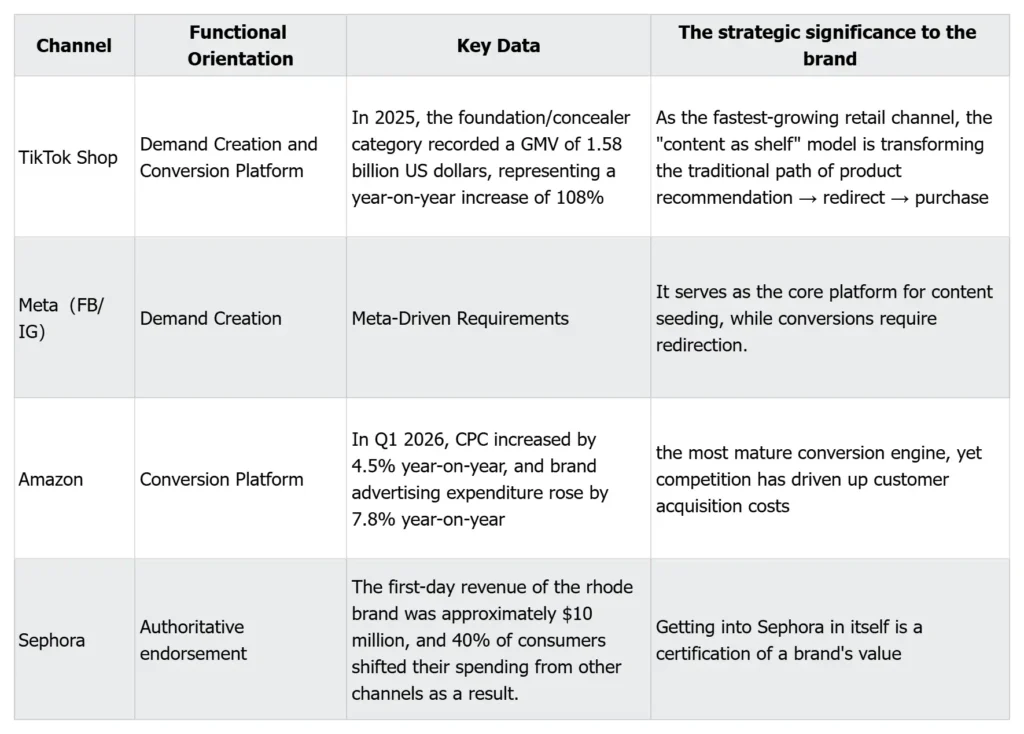
The sales channels for foundation are undergoing structural changes, and the roles and competition rules of different channels are vastly different:
6.2 TikTok Shop: The Fastest-Growing Channel for Foundation Category
In 2025, the foundation and concealer category on TikTok Shop generated a GMV of 1.58 billion US dollars, representing a 108% year-on-year growth. This growth rate far outpaced the overall e-commerce growth rate of the US (around 10-15%) and also greatly exceeded the average growth rate of the beauty category.
The Success Rules of the Foundation Category on TikTok Shop:
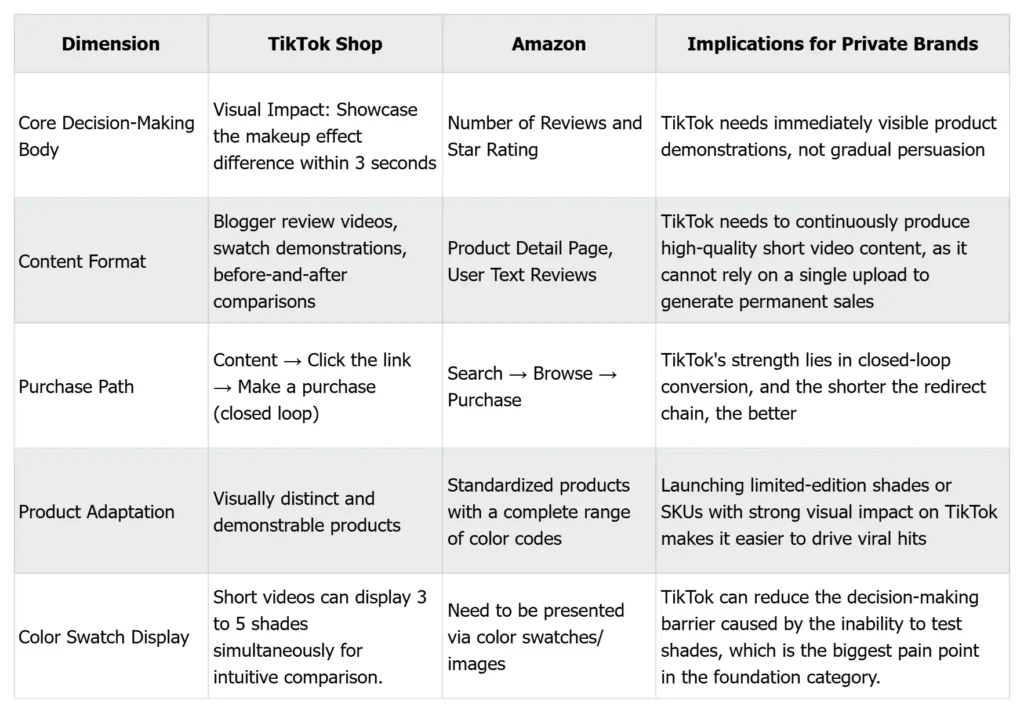
In the TikTok ecosystem, the competition rules for the foundation category are completely different from those of other channels:
Insights for private labels: If you plan to enter the US foundation market, TikTok Shop should be the launch channel for your product. It allows you to test market response at a lower cost (gauge product appeal via video views and Engagement Rate), accumulate authentic user-generated video content (which can in turn feed into Amazon and your standalone site), and directly verify the product’s sales conversion rate through closed-loop conversion.
6.3 Amazon: The Search Battlefield of the Foundation Category
Amazon is the most mature conversion engine in the foundation category. However, data from 2026 shows that customer acquisition costs on Amazon are rising rapidly.
CPC increased by 4.5% year-on-year: Amazon Ads’ cost per click (CPC) rose 4.5% in Q1 2026 compared with Q1 2025. This means that:
- Even if the same advertising budget is maintained, the number of clicks that can be obtained is decreasing.
- For foundations in the $15-30 price range, the proportion of advertising costs has increased from 15-20% to 20-25%
- With profit margins being squeezed, a higher product conversion rate and repurchase rate are required for hedging.
Brand advertising expenditure rose by 7.8% year-on-year: the growth rate of brand advertising expenditure (7.8%) is higher than that of CPC (4.5%), which indicates that brands are:
- Shift from purchasing keyword traffic to building brand awareness
- Allocate more budget to assets such as brand flagship stores, brand stories and brand videos
- This is a signal that the market is shifting from product competition to brand competition
Implications for private labels: On Amazon, competition in the foundation category has shifted from who can buy more keyword traffic to who can build stronger brand awareness. A private label with only 2-3 product SKUs, no brand store, and no video content will find it extremely difficult to turn a profit on Amazon in 2026.
6.4 Sephora: The Certification of Brand Value
Getting into Sephora is in itself a certification of brand value. On its first day of launch at Sephora, the rhode brand generated approximately $10 million in revenue, with 40% of consumers shifting their spending to the brand from other channels.
Caution is warranted when interpreting this figure, but for private label brands, it is important to understand that the strategic significance of the Sephora channel lies not in its sales contribution, but rather in its function as a brand trust endorsement.

Implications for private labels: Sephora is suitable as a channel strategy in the second stage — after the product has been market-validated (with sufficient reviews and user word-of-mouth), the brand image is mature (with a complete brand story and visual system), and the supply chain is stable (capable of meeting Sephora’s order scale and return processing requirements), listing on Sephora can be taken as a milestone for brand upgrading.
6.5 Correspondence Logic of Channel-Product-Technology
Different sales channels have different requirements for products. Private brands should select matching channels based on their own product positioning instead of distributing products across all channels.
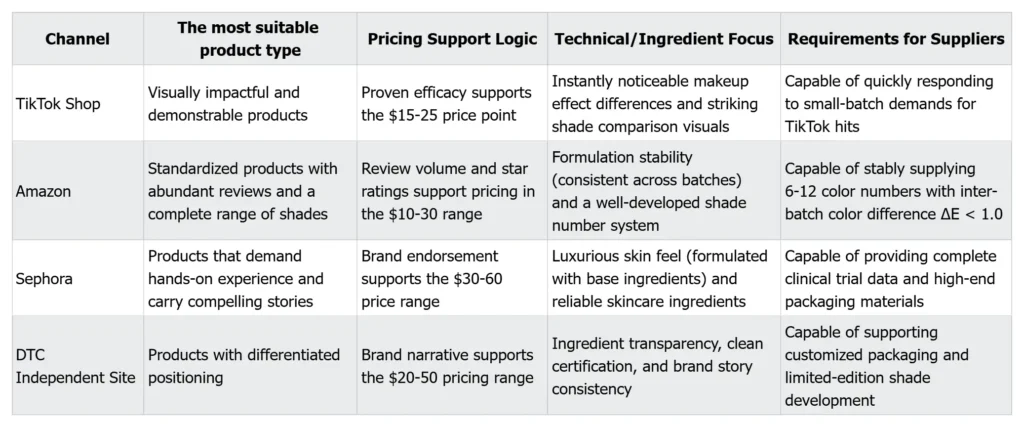
6.6 Brand Competition Landscape: The Giants’ Turf and the Cracks of Private Brands
Complete Analysis of the Four-Tier Brand Structure:
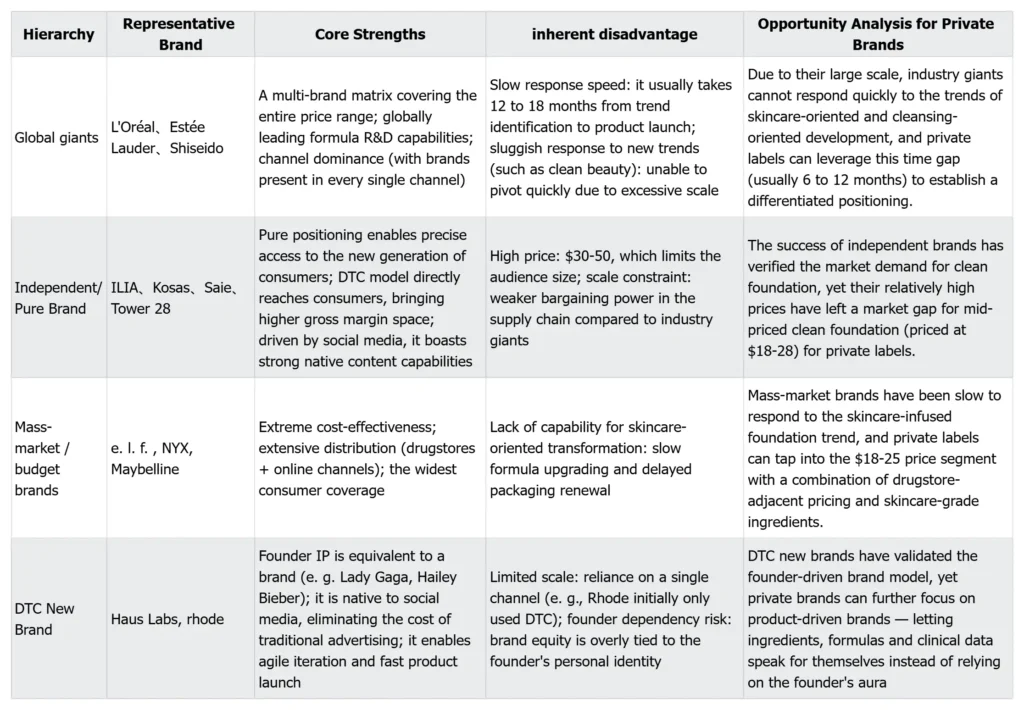
Niche Strategy for Private Brands:
Based on the above pattern analysis, the market opportunities for private labels are concentrated in the following three niche segments:
Gap 1: Mid-range sheer foundation – in the $18-28 price bracket, positioned to compete with independent brands but at a lower price point
Pure foundations from independent brands (ILIA, Kosas) are priced at $30-50, while there are extremely limited options for pure foundations from mass-market brands. Private labels can leverage their supply chain cost advantages to launch pure foundations that boast formula quality close to independent brands and prices close to mass-market brands. Core selling points: infused with XX active ingredients, silicone-free, fragrance-free, dermatologist-tested — and priced at only 60% of premium brands.
Crack 2: Skincare-based drugstore foundation – in the $15-22 price range, targeting mass-market brands but with superior efficacy
Foundation products from mass-market brands (e. g. Maybelline, L’Oréal) are upgrading their skincare ingredients (for instance, Fit Me contains niacinamide), yet the upgrading pace is slow and their claims remain conservative. Private labels can take a more aggressive approach by adding functional ingredients (such as the combination of niacinamide and salicylic acid), and capture ingredient-sensitive consumers with more definite efficacy promises.
Crack 3: The Shade Code Revolution – More Diverse Than Mass Brands, More Affordable Than Independent Brands
Fir Beauty has demonstrated market demand for 40+ shades, though its price point of $35+ has put it out of reach for some consumers. About Face (priced at $22) has validated the viability of offering 45+ shades at a mid-range price point. Private label brands can carve out a niche in the segment of 20-30 shades paired with a $20-25 price point, and build a perception of professionalism through the breadth of their shade offerings.
7. Specification Strategy and Supply Chain Decisions
7.1 The Specification Trap of Foundation: Why Capacity Selection Matters More Than the Price Itself?
The specification design of foundation directly influences consumers’ decision-making behavior and the perceived value of the brand. Different from lip products, the specification selection of foundation involves unique commercial logic.
Foundation: Volume-Price Correlation:

The complete logic of launching the mini size first followed by the standard size:
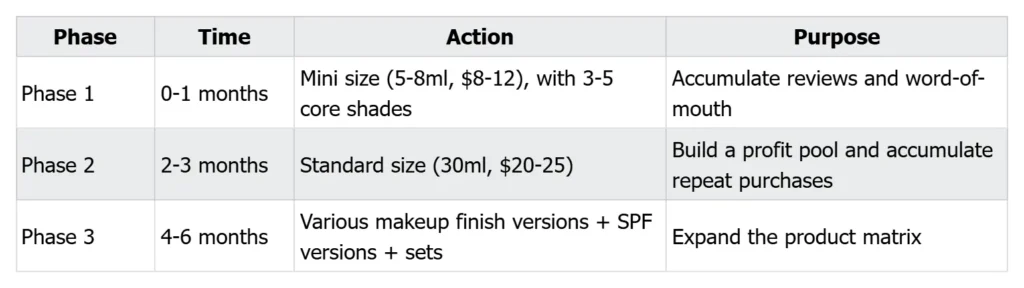
For private labels, launching mini sizes (5-8ml, $8-12) first followed by standard sizes (30ml, $18-25) is a more effective approach than directly rolling out standard sizes. The complete commercial logic chain is as follows:
Phase 1 (0-1 month): Launch of mini-sized packaging (5-8ml, $8-12)
- Lower the threshold of trust: The core pain point of the foundation category lies in the high trial-and-error cost — consumers have no idea whether a certain foundation suits them. The mini-sized products priced at $8-12 fall into the no-pressure trial range, making consumers willing to place an order just to give them a try.
- Accumulate early reviews: Mini-sized products are the fastest way to accumulate authentic user reviews and word-of-mouth. In the foundation category, the first negative review on a product page is enough to kill the sales conversion rate.
- Collect feedback on shade numbers: Gain insights into the most popular shades and those with high return rates based on sales data of mini-sized products, so as to provide data support for the shade strategy of standard-sized products
Step 2 (2-3 months): Launch of the standard package (30ml, $18-25)
- Leverage review conversion: The reviews accumulated for the mini size serve as a foundation of trust for the standard size — when consumers see numerous positive reviews from other users, their decision-making risk is reduced.
- Build a profit pool: the unit profit of standard packs is much higher than that of mini packs, making them the core source of the brand’s revenue and profits
- Repurchase path: The repurchase conversion rate from mini size to standard size is high, because consumers have confirmed that this product suits them
Step 3 (4-6 months): Expand the product matrix
- Available in multiple finish variants: matte, dewy, and natural, catering to your makeup wardrobe needs
- SPF Version: Foundation with sun protection factor, targeting summer/outdoor scenarios
- Set bundle: Entry-level kit consisting of foundation + primer + setting powder to increase average transaction value
7.2 Supply Chain Capability Verification Checklist
Formulation and Ingredient Capabilities:

Color Code Development Capability:
The cost of developing foundation shades far exceeds that of lip products. Each additional shade means:
- Independent adjustment and debugging of color paste formulas (each color code corresponds to a unique independent formula)
- The development of foundation shades usually requires 3 to 5 rounds of sampling to achieve a stable skin feel and consistency.
- Each color shade requires independent stability testing and packaging testing.
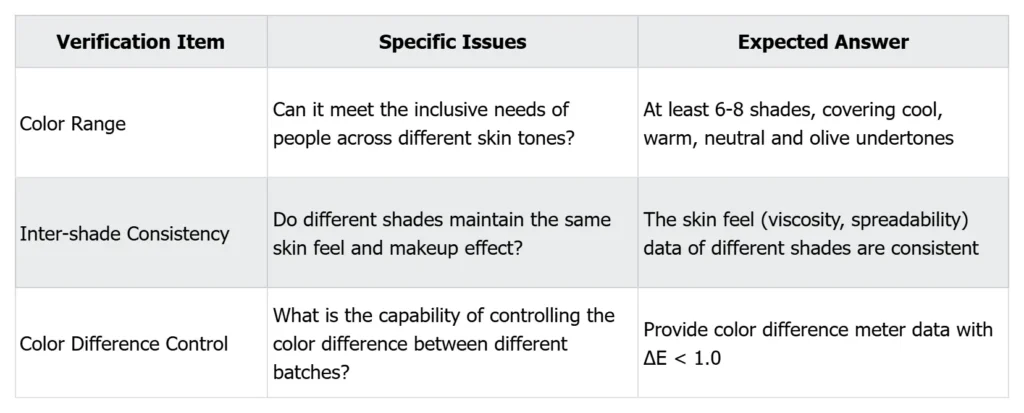
Supply Chain Responsiveness:

Collaborative Relationship Between Channels and Supply Chains
Distribution channels determine product strategy, and product strategy determines supply chain requirements:
- If your target channel is TikTok Shop, what you need is a supply chain partner that can respond quickly and support small-batch testing of multiple color variants, as hit SKUs on TikTok change extremely fast, and the product portfolio may need to be adjusted once every 3-6 months
- If your target sales channel is Amazon, what you need is a supply chain partner with a complete color number system and strict control over color difference between batches, since Amazon consumers rely on reviews to make purchase decisions, and inconsistent product batches will lead to a concentrated outbreak of negative reviews
- If your target channel is Sephora, what you need is a supply chain partner that can provide complete clinical test data, high-end packaging customization capabilities, and handle bulk return processing, as Sephora has the strictest qualification review requirements for suppliers
Matching of Specification Strategies and Supply Chain Capabilities:
- The strategy of prioritizing the launch of mini sizes requires the supply chain to support small-capacity filling of 5-8ml (which usually demands additional filling lines and packaging material molds), and not all factories are capable of meeting this requirement.
- The multi-shade strategy requires the supply chain to have the capability to independently adjust and formulate the recipe for each individual shade (rather than simply adding different colorants to a base formula), which calls for genuine R&D competence instead of mere mixing operations.
The Linkage Between Channel Selection and Pricing:
- The $15-25 price point on TikTok Shop requires supply chain cost support (with FOB cost controlled within $3-5)
- Sephora’s $30-60 price point requires the supply chain to provide justifications for the premium, such as clinical test reports, high-end packaging, and naturally sourced ingredients.
- Amazon’s $10-30 pricing requirement calls for the supply chain to strike a balance between consistent quality and cost control
The collaborative capability across these three dimensions — channel selection, SKU strategy, and supply chain capacity — serves as the critical watershed for a private-label foundation business to evolve from trial operation to large-scale deployment.
The High Barriers and Niche Entry Points of the Foundation Category
Attractiveness of the Category
- The US market reaches USD 2.43 billion and continues to grow at a rate of 6.5%
- High consumer loyalty: once they find the right foundation, consumers will not switch to alternatives easily
- High unit price: mid-range foundation costs $20-30, which is far higher than that of lip products
Category Barriers
- Shade inclusiveness: 6 to 20 shades, with the formula and skin feel of each shade being strictly consistent
- Formulation Stability: A Complex Multiphase System Consisting of Water, Oil, Colorants and Active Ingredients
- Skincare efficacy verification: Consumers expect dual validation of both makeup performance and skin-nourishing benefits, which must be supported by clinical test reports
- Makeup consistency: Ensure the same skin feel and makeup effect across different shades
The Reasonable Path for Private Label Sellers
Core Decision-Making Framework
The growth story of the foundation category is still being written — the market expansion from 2.4 billion USD to 4.3 billion USD essentially answers a more fundamental question:
When consumers can achieve both makeup effects and skin care benefits with a single product, how much are they willing to pay for it?
For private label sellers, the real competitive edge lies not only in formula technology and ingredient innovation, but more importantly in the ability to prove product value to consumers and distribution channels with complete clinical trial data. This is the watershed moment that separates mere product selling from brand building.
CTA:
Contact our team to discuss your foundation line strategy.
Return to the main guide on private label foundation sourcing for a complete strategic overview.
Keep Reading:
- Dive deep into formulation science
- Decode functional ingredients
- Master the “silent 90%” of base ingredients
- Navigate efficacy testing & compliance
Explore More: