
Scientific Foundation Formulation: Disassembly of Emulsification System and Functional Modules
Table of Contents
Original version:
As the cornerstone of daily makeup, foundation has long gone beyond the mere function of skin tone correction. Modern foundation represents a sophisticated discipline that integrates colloid chemistry, dermatological science, and bioactive ingredients. Starting from the most fundamental emulsification system, this article will thoroughly break down the functional modules of foundation formulas, helping private brand sellers build a systematic understanding of formulation science.
I. The Backbone of Foundation: Emulsification System
Foundation is essentially an emulsion — a thermodynamically unstable system formed by the oil phase and water phase under the action of an emulsifier. Understanding the emulsion system is the starting point for understanding all subsequent issues related to foundation formulations.
1.1 Two Basic Types: Oil-in-Water vs. Water-in-Oil
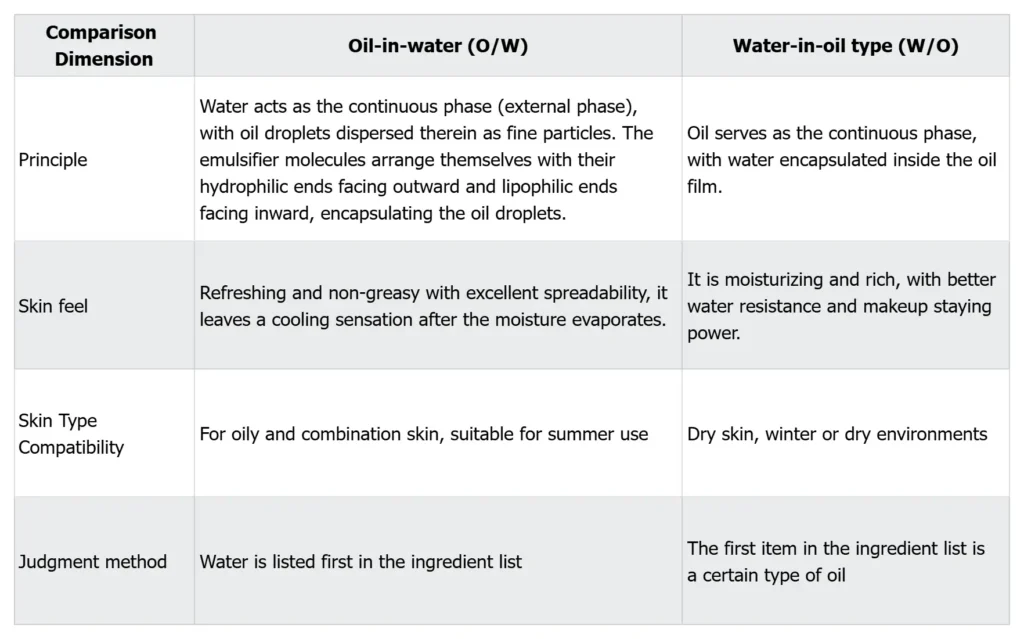
1.2 The Science of Emulsifier Selection: HLB Value
The selection of emulsifier depends on the target skin feel and stability of the formulation. The HLB value (Hydrophile-Lipophile Balance) is a quantitative indicator for emulsifier selection:
- HLB value 3-6: Strong lipophilicity, suitable for water-in-oil (W/O) systems
- HLB value 8-18: Strong hydrophilicity, suitable for oil-in-water (O/W) systems
Business Case: In silicone-oil-free foundation formulations, the naturally derived water-in-oil emulsifier Emulium® Illustro can be used to prepare an emulsified system with a specific viscosity, which effectively enhances the color spreadability of base makeup products and imparts a moisturizing skin feel. Meanwhile, the silicone emulsifier DOWSIL™ ES-5300 is capable of forming low-viscosity water-in-oil emulsions, featuring excellent pigment dispersion performance and high flexibility in the selection of formulation oil phases.
1.3 Modern Formulation Trends: Multiple Emulsion Systems
To meet the dual requirements of refreshing application and long-lasting waterproof performance, modern formulations have evolved to develop the water-in-oil-in-water (W/O/W) multiple emulsion system. The technical threshold for such formulations lies in:
- Internal phase stability: The internal phase droplets must not rupture during processing and storage
- Particle size control: The particle size distribution of multiple emulsions directly affects skin feel and stability
- Preparation process: A two-step emulsification method is required, which imposes high requirements on equipment and control accuracy
Requirements for the supply chain: the capability to stably produce multiple emulsion systems is a key indicator that distinguishes the technical level of contract manufacturers. When requesting quotations from potential suppliers, you can ask them to provide cases of commercialized water-in-oil-in-water formulations and corresponding stability data (such as results of centrifugal testing and accelerated aging testing).
1.4 Non-Newtonian Fluids and Rheological Design
As a type of non-Newtonian fluid, foundation’s rheological properties directly determine its application experience, pump dispensing behavior and spreadability on the skin. Formulation engineers design the shear-thinning behavior by compounding thickeners and gelling agents:
- At rest (inside the bottle): High viscosity prevents pigment settling
- During application (when shear force is applied): Low viscosity, enabling easy spreading
- After application (when shear force disappears): medium viscosity, forms a uniform film
Commonly used oil-phase rheology modifiers include:
- BENTONE GEL® GTCC V: A preformed organically modified lithium montmorillonite gel that delivers efficient suspending capacity and thixotropy, enhances system stability, and imparts a silky skin feel
- THIXCIN® R PC: A natural and sustainable oil-phase thickener that features high thixotropy, provides product hardness and viscosity, and enhances the suspension property and physical stability of products
2. Breakdown of Foundation Function Modules (From the Perspective of Formulation Engineers)
Referring to the formulation structure of a complete water-in-oil-in-water foundation, the formula can be broken down into seven functional modules. The technical choices for each module directly impact the end-user experience and cost structure of the final product.
2.1 Overview of the Seven Functional Modules
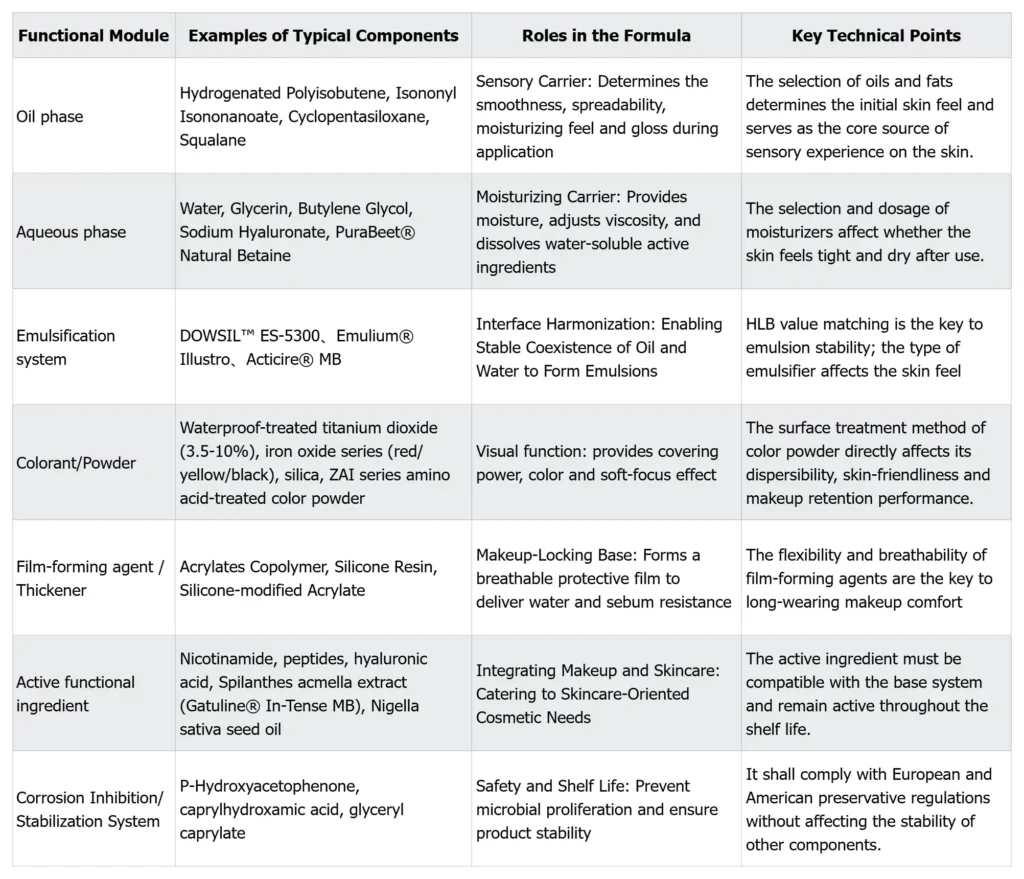
2.2 Technical Key Points and Commercial Impacts of Each Module
Oil Phase: The First Touch of Skin Feel
The composition of the oil phase determines the first impression users get when applying the product. Designing the oil system is one of the core skills for formulation engineers. In a water-in-oil system, the oil phase itself is also part of the occlusive film, so the selection of the oil phase directly affects the skin feel after film formation.
- Lightweight oil phase (isododecane, caprylic/capric triglyceride): delivers quick spreading and a fresh, lightweight feel
- Moisturizing oil phase (squalane, meadowfoam seed oil): provides nourishing sensation and gloss
- Film-forming oil phase (hydrogenated polyisobutene, silicone oil): provides the base for long-lasting makeup
Business Insight: Mid- to low-priced products often cut costs by lowering the quality of the oil phase, such as replacing vegetable oil with mineral oil and reducing the addition of functional oils, but this comes at the cost of a rough skin feel and post-application dryness.
Powder and Surface Treatment Technology: The Core Determining Makeup Wear Performance
The surface treatment technology of foundation base powder is one of the most critical factors affecting the makeup staying effect:
- Untreated toner: Poor dispersion in the oil phase, uneven makeup finish, and prone to migration
- Colorants treated with silicone oil (e. g., treated with triethoxyoctylsilane): Good dispersibility, but contains organosilicon components, which fails to meet the silicone-free positioning
- Amino Acid Treated Color Powders (ZAI Series, NAI Series): Made with naturally derived surface treatment agents, they feature excellent skin compatibility, adhesion, and emulsification stability.
- Double surface-treated colorants (e. g. MiyoSTAY EL series): feature excellent dispersibility in oils and deliver long-lasting makeup performance for formulations
The difference in pigment treatment is clearly reflected in the price: the cost of water-resistant treated titanium dioxide is 30-50% higher than that of ordinary titanium dioxide, which is the underlying reason why low-priced foundations tend to darken quickly and have poor staying power.
Film-forming Agent: The Balance Between Long-lasting Makeup and Comfort
The choice of film-forming agent determines the balance between long-lasting makeup wear and comfort:
- Hard film-forming agents (such as MQ resin): feature long-lasting makeup wear but poor flexibility, which may cause a tight sensation on the skin
- Soft film-forming agent (e. g. silicone-modified acrylate): forms a flexible, breathable film, delivers a soft and smooth skin feel, and provides long-lasting makeup effect
Modern formulations tend to adopt a combination of hard and soft components: hard film-forming agents build the framework, while soft film-forming agents deliver a comfortable feel.
3. The Significance of Emulsion Systems in Commercial Decision-Making
For private label sellers, the selection of an emulsification system is not a purely technical issue, but a business decision directly linked to product positioning and cost.
3.1 Correspondence Between Emulsification System and Target Customer Group

3.2 Judging Product Positioning Based on the Emulsification System
You can quickly judge the emulsification system and technical level of a product by looking at the first few items in its ingredient list:
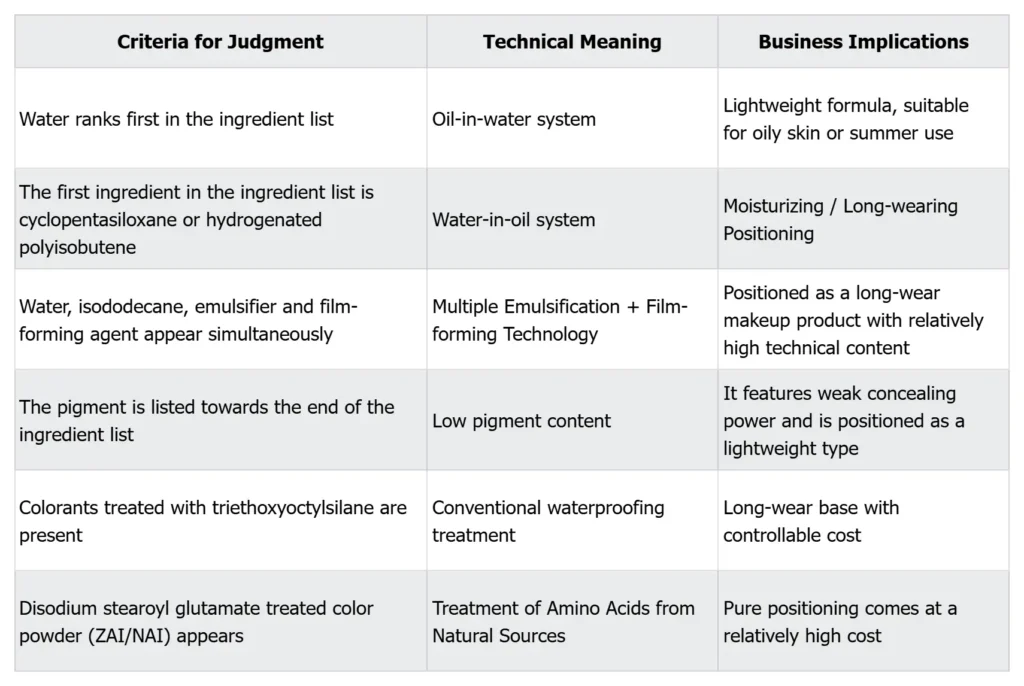
3.3 Emulsifier-Free Formulation (Trend Observation)
With the rise of the clean beauty trend, some brands have begun experimenting with emulsifier-free formulas — which achieve oil-water dispersion by relying on the surface activity of the powder itself or special processes, eliminating the need for traditional emulsifiers. However, the stability of such formulas remains an industry challenge, and their large-scale monetization still requires verification.
4. Reference for Formula Cost Structure
For private label sellers, understanding the formula cost structure of products at different price points helps them make reasonable pricing and procurement decisions.

Reference for data sources: The above figures are based on industry research on foundries, and the specific costs will fluctuate depending on factors such as the production capacity of OEM factories, raw material procurement volume, and order scale. When requesting quotations for private brands, it is recommended to obtain quotations from 3 to 5 suppliers for horizontal comparison.
The true high-value competitive edge of a foundation formula lies in the rheological design of the oil-phase system, the stability control of multiple emulsions, and the synergy between pigment surface treatment and film-forming technology. When selecting products for private labels, rather than focusing on what active ingredients (0.1-5%) have been added, it is better to first evaluate the quality level of the base system (70-95%), as the latter determines over 90% of the actual user experience.
CTA:
Contact our team to select the right actives for your target audience.
Return to the main guide on private label foundation sourcing for a complete strategic overview.
Keep Reading:
- Back to Category Decision Manual
- Understand Formulation Basics First
- Why Base Ingredients Matter
- Plan Your Testing Strategy
Explore More: